
開催予定
ウェビナー
Zoom10/21
From Prompt to Simulation: Coding Agents on Matlantis – Natural Language Workflows for Atomistic Simulations
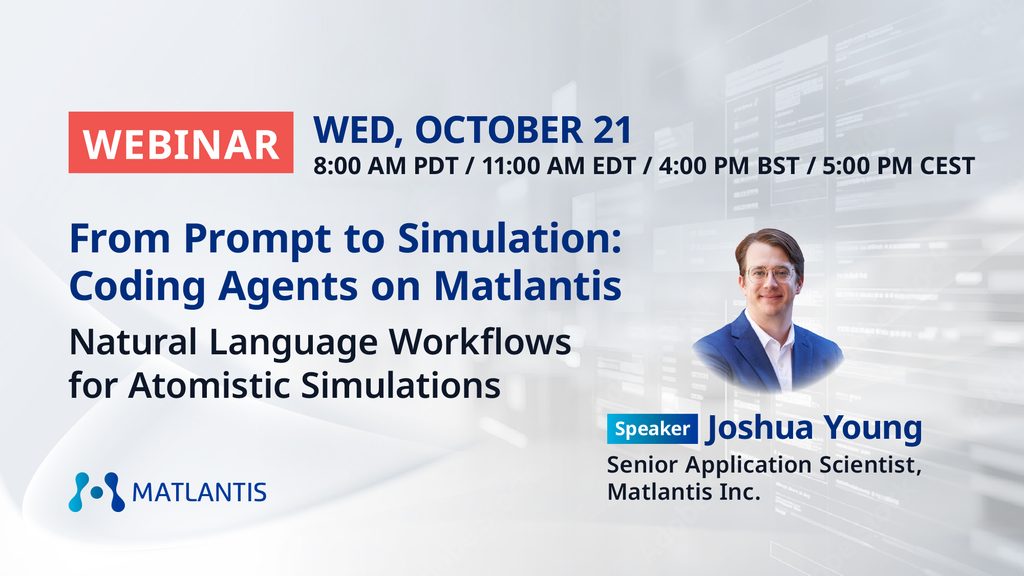
Coding agents that write and run code from instructions in natural language are beginning to change how atomistic simulations are set up and run. This webinar shows how to use them with Skills for Matlantis, and what they can and cannot do today.
Who should attend
- Researchers considering atomistic simulation for their work, including those without a background in computational chemistry
- Computational scientists who want to spend less time on setup and post-processing
- R&D teams interested in using coding agents for simulation workflows
Outline
Atomistic simulation involves a good deal of work around the analysis itself: building structure files, choosing calculation settings, and then collecting and plotting the results. These steps can take up much of a project’s time. How to set up and run the calculations has also depended largely on the experience of specialists, which has made it hard for researchers from other fields to get started.
As generative AI tools such as ChatGPT and Claude have advanced, coding agents, which write and run code from instructions given in natural language, are now being used in R&D as well. Matlantis has released Skills tailored to its simulation workflows, and this webinar shows how to put coding agents to work on atomistic simulations.
When simulations can be driven through conversation in natural language, experienced users can leave routine work to the agent and spend their time on the questions they actually want to investigate. Researchers who have relied on specialists are also starting to be able to try those calculations themselves. Drawing on examples of projects carried out with coding agents, the session looks at what coding agents can already handle, how to get good results from them, and where their limits currently lie.
These calculations run on Matlantis PFP, a universal machine learning interatomic potential covering 96 elements, so no system-specific model needs to be trained.
Speaker
Joshua Young
Senior Application Scientist,
Matlantis Inc.
Joshua received his Ph.D. in Materials Science and Engineering from Drexel University, followed by appointments at the Naval Research Laboratory, Binghamton University, and the New Jersey Institute of Technology. Over the course of his career, he has used a wide variety of computational techniques, including density functional theory, molecular dynamics, and materials informatics/machine learning, to study and design materials for electronics, batteries, catalysis, and more.

Webinar Details
| Date and Time | Wednesday, October 21, 2026 8:00 AM PDT / 11:00 AM EDT / 4:00 PM BST / 5:00 PM CEST (12:00 AM (midnight) JST, October 22) |
| Location | Online (Zoom) |
| Fee | Free |
| Notes | *This webinar is intended specifically for R&D professionals and academic researchers. We kindly ask individuals from competing organizations to refrain from accessing this content. *A Japanese-language on-demand webinar on the same topic is available here for Japanese-speaking audiences. |
Apply here
公開日:2026.10.08
-


 URLを
URLを
コピーしました
新着イベント・セミナー
NEW
過去のお知らせ
ウェビナー
onlineThursday, October 1, 2026
Crystal Structure Prediction in Practice: Setting Up Searches and Reading Results with Matlantis CSP

動画配信
ウェビナー
OnlineOn-demand
[On-Demand Webinar] Simulating Semiconductor Unit Processes with a Universal Machine-Learning Potential

動画配信
ウェビナー
OnlineOn-demand
[On-Demand Webinar] Accelerating Computational Materials Design with CALPHAD, DFT, MLIPs, and AI Agents

大手町9:30
ハンズオンセミナー | Matlantisで始める計算化学 〜初歩から実践まで〜

動画配信
ウェビナー
オンライン配信今すぐ視聴可能
【オンデマンド】コーディングエージェントで広がるMatlantis活用―自然言語で進める計算化学の新しいワークフロー―