
2026.8.6
Events & Seminars
ACS Fall 2026 Announcement
Matlantis Corporation will have one member present a poster and an oral presentation at "ACS Fall 2026," which will be held in Chicago, USA (McCormick Place Convention Center) from August 23rd to August 27th, 2026 (Central Daylight Time/CDT). Please see below for details.
Presentation Details ① (Poster Presentation: Sci-Mix)
Room: Hall F2 – POSTERS (McCormick Place Convention Center)
Poster board number: 1506
Presenter 1: Kota Matsumoto
Session: ENFL Sci-Mix
Date and time: Monday, August 24, 2026, 8:00 PM – 10:00 PM (Central Daylight Time/CDT)
*Japan time: August 25th (Tue) 10:00 – 12:00
Department: ENFL: Division of Energy and Fuels
Session type: Poster (Sci-Mix)
Title: Analysis of structural stability and irreversible structural transformations in Li-ion battery cathode materials using a universal machine-learning interatomic potential and autonomous transformation pathway exploration
* Sci-Mix is a cross-departmental poster session consisting only of outstanding presentations selected by the program chairpersons of each department from among the accepted presentations.
Presentation Details ② (Oral Presentation)
Room: N134 (McCormick Place Convention Center)
Presenter 1: Kota Matsumoto
Session: Earth-Abundant and Low-Cost Rechargeable Battery Chemistries
Date and time: Wednesday, August 26, 2026, 3:30 PM – 3:45 PM (Central Daylight Time/CDT)
*Japan time: August 27th (Thu) 5:30 – 5:45
Department: ENFL: Division of Energy and Fuels
Session type: Oral
Title: Analysis of structural stability and irreversible structural transformations in Li-ion battery cathode materials using a universal machine-learning interatomic potential and autonomous transformation pathway exploration
Overview
[Introduction]
Extending usable capacity in lithium-ion batteries hinges on preventing irreversible structural change in the cathode. Layered rock-salt oxides LiMO₂ (M = Ni, Co, Mn) dominate commercial use, yet lose capacity through transition-metal migration that triggers phase change, typified by layered-to-spinel conversion. Because the kinetics are governed by individual hopping barriers, resolving the atomistic sequence of migration events is a prerequisite for rational stabilization by doping. Such events carry barriers far too high for direct MD. NEB, the standard alternative, requires end points and an initial path to be specified and copes poorly with the pronounced cell-shape changes involved; earlier work has therefore been confined to assumed mechanisms such as dumbbell formation, leaving unknown intermediates undiscovered. SC-AFIR removes both restrictions — automatic exhaustive search, access to high barriers, tolerance of lattice deformation — but its use for periodic solids has been throttled by DFT cost. Here we lift that constraint by driving SC-AFIR with a machine-learning interatomic potential (MLIP).
[Method]
SC-AFIR in GRRM20 was coupled to the universal MLIP Matlantis PFP (hereafter PFP), enumerating minima and connecting transition states without prior mechanistic assumptions.
[Results and Discussion]
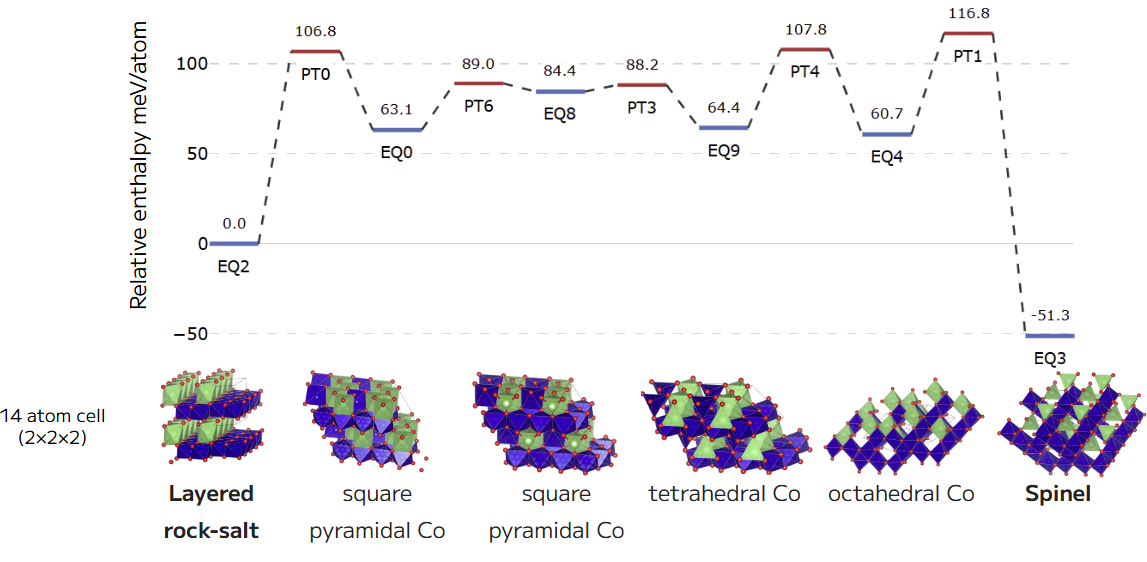
For Li₀.₅CoO₂, where Co displacement into the Li layer beyond 50% Li extraction caps practical capacity, the search yielded 1,008 minima and 1,882 pathways, from which the kinetically dominant layered-to-spinel route was extracted (Fig. 1). Its highest barrier — the first Co hop — was ~1.5 eV for a 14-atom cell, in line with published values. Notably, the favored route is multistep, passing through square-pyramidally coordinated Co and Co at an octahedral site in the Li layer — intermediates inaccessible to assumed-pathway calculations. Dopant effects and other cathode compositions will also be presented.
Presenter Profile
Kota Matsumoto
Matlantis Corporation Customer Success Engineer
After completing his graduate studies at the Graduate School of Integrated Chemistry, Hokkaido University, he joined ENEOS Corporation, where he was involved in research on materials development using computational chemistry, verification and development of Matlantis, and interface development for "GRRM20 with Matlantis." Subsequently, he joined Preferred Computational Chemistry, Inc. (now Matlantis Corporation). Currently, he works as a Customer Success Engineer, engaged in application development using Matlantis.
-


 URL
URL
Copied
Related News
-
2026.8.5Events & SeminarsNEW
Invited Talk at CCP2026, the IUPAP Conference on Computational Physics
-
2026.8.3Events & SeminarsNEW
Hands-on Seminar | computational chemistry with Matlantis: From Basics to Practical Applications
-
2026.7.31Events & SeminarsNEW
