
2026.6.22
Events & Seminars
Exhibiting at AVS ALD/ALE 2026 (Booth #423)
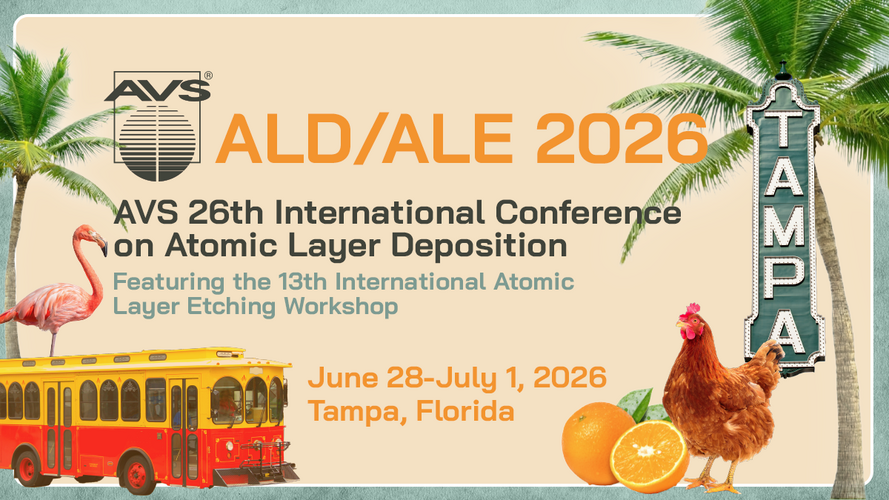
Matlantis will be exhibiting at AVS ALD/ALE 2026, held in Tampa, Florida, USA from June 28th to July 1st, 2026, at booth #423. We will be introducing the applications of Matlantis in the semiconductor process field and will also be available for technical discussions.
Event Overview
- Conference name: AVS 26th International Conference on Atomic Layer Deposition (ALD 2026) / 13th International Atomic Layer Etching Workshop (ALE 2026)
- Date: June 28th (Sunday) - July 1st (Wednesday), 2026
- Venue: JW Marriott Tampa Water Street, FL, USA
- Matlantis Booth Number: #423
- Booth hours (local time EDT):
- June 28th (Sun) 18:00–20:00 (Welcome Reception)
- Monday, June 29th 10:00–19:00
- June 30th (Tue) 10:00–19:00
- Wednesday, July 1st 10:00–13:30
- Organized by: American Vacuum Society (AVS)
- Official site: https://ald2026.avs.org/
ALD/ALE and Matlantis
The universal atomistic simulator Matlantis can contribute to understanding atomic-scale phenomena such as precursor adsorption, surface reactions, and interface formation in ALD/ALE. Powered by PFP, our universal machine-learning interatomic potential, Matlantis accelerates pre-experiment candidate screening, mechanistic understanding, and process condition optimization.
What to expect at Booth #423
- Matlantis applications in semiconductor processes (ALD/ALE)
- Discussion with technical members
- Distribution of product brochures
Related Resources
- Calculation Example: Analysis of Surface Reaction Mechanism between ALD Precursor and Si Substrate
- Calculation Example: SiO2 Dry Etching Simulation using LightPFP
- Customer Case Study: Prof. Shimogaki of the University of Tokyo talks about two “Before and Afters” with Matlantis
-


 URL
URL
Copied
Related News
-
2026.8.18Events & SeminarsNEW
-
2026.8.7Events & SeminarsNEW
-
2026.8.6Events & SeminarsNEW
