2026.2.20
Learning AI materials simulation to accelerate research at the Fukui Kenichi Memorial Research Center, Kyoto University - Working with ENEOS to design the "best CO2 adsorbent"
On November 7, 2025, a lecture and practical training session using "Matlantis," an AI materials simulation platform jointly developed by Preferred Networks, Inc. and ENEOS Corporation, was held at the Fukui Kenichi Memorial Research Center, Kyoto University, as part of the "Basic Chemistry for Industrial Applications" course for doctoral students and corporate researchers. The lecture was led by Masao Oba, Chief Staff of the Digital Business Development Group in the AI Innovation Department at ENEOS Holdings Corporation (ENEOS), a company at the forefront of advancing AI utilization in industry. Simulation experts from the company also participated as assistants. Approximately 20 participants, both online and offline, experienced the realities of AI-assisted materials design and learned practical ways to use simulations to link basic chemistry with industrial applications.
The lecture, titled "AI Pioneering the Cutting Edge of Materials Design," consisted of a 30-minute lecture and a 150-minute practical session. The practical session, in particular, focused on a theme directly linked to a social issue: "Creating the Best Adsorbent for Direct Air Capture (DAC)." Leveraging the overwhelming speed of AI simulations, participants experienced a rapid cycle of hypothesis testing.
"To do applications, you must master the basics": The tradition of the Fukui Kenichi Memorial Research Center and the ENEOS lecture
The Fukui Kenichi Memorial Research Center at Kyoto University is a research center that develops cutting-edge basic and theoretical chemistry, inheriting the research philosophy of Dr. Kenichi Fukui, who was awarded the Nobel Prize in Chemistry in 1981. This course, "Basic Chemistry for Industrial Applications," is open to engineers and researchers involved in research and development in the industrial sector, and carries on the spirit of the words of Dr. Gen'itsu Kita, whom Dr. Fukui regarded as his "lifelong mentor," who said, "To do applications, you must do the basics."
ENEOS will continue to be in charge of this course in 2024, conveying cutting-edge materials development methods using Matlantis, along with the importance of basic chemistry.
"AI x Quantum Chemistry": Changing the Common Sense of computational chemistry
In the first half of the lecture, lecturer Ooba from ENEOS took the stage and gave a lecture titled "The cutting edge of materials design opened up by AI."
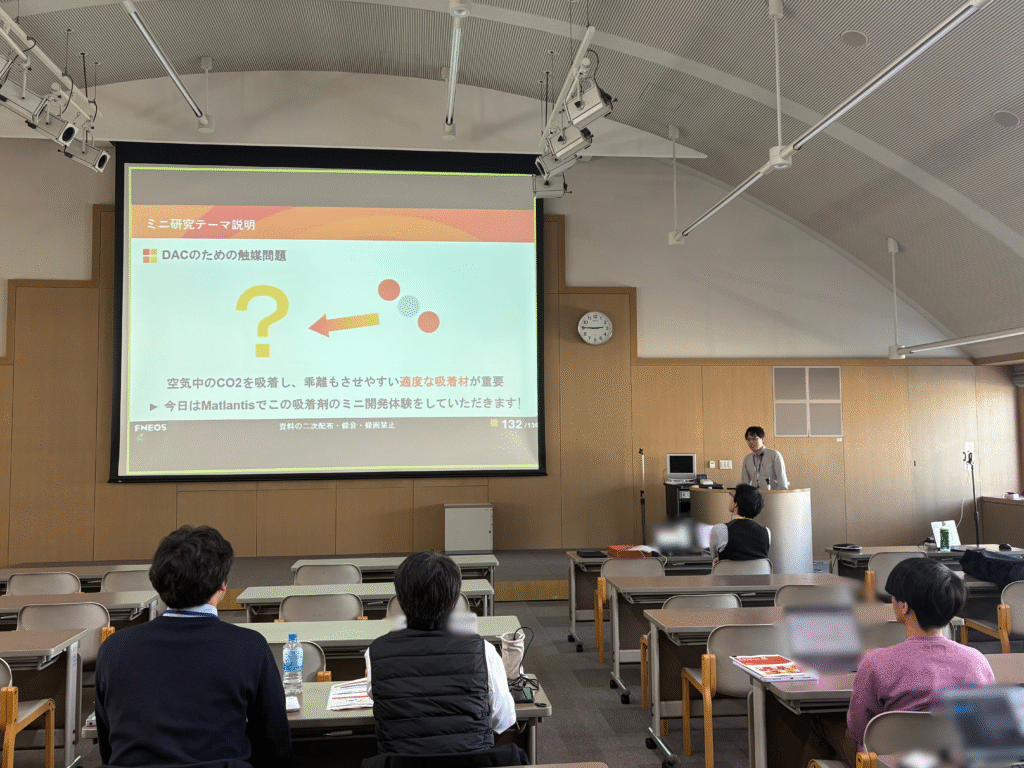
First, we identified the issues with conventional simulation methods in materials development. First-principles calculations (DFT) are highly accurate, but require enormous computational costs and are limited in the number of atoms and time that can be handled. On the other hand, classical force fields are fast, but because they do not explicitly treat electronic structures and assume fixed bonds, they are limited in their ability to reproduce reactions involving bond breaking/creation and electron rearrangement.
The potential of machine learning was introduced as a third option to bridge this gap between accuracy and efficiency. Matlantis, jointly developed by ENEOS and Preferred Networks (PFN), trains on a vast amount of first-principles calculation data, achieving approximately 20 million times the speed of conventional methods while maintaining accuracy.
Furthermore, it is versatile enough to support all 96 elements of the periodic table, and is convenient enough to start using immediately in a browser. Oba cited an example in which a comprehensive analysis of a catalytic reaction that would previously have taken 20 years was completed in just one week, emphasizing that "the calculation and analysis cycle has dramatically sped up, and research and development is evolving."
Practical part: "Let's make the best DAC adsorbent"
In the second half of the practical session, participants worked in groups, operating Matlantis, on the theme of "Let's create the best adsorbent for DAC (Direct Air Capture)." DAC is a technology that directly captures CO2 from the air and reuses it for synthetic fuels, etc., and is one of the key technologies toward realizing a decarbonized society. Its practical application is also progressing, with buses using fuel generated using this technology being operated at the Osaka Expo. In the practical session, participants attempted to design and verify "molecular design for CO2 adsorption," the key element of the DAC process, on Matlantis.
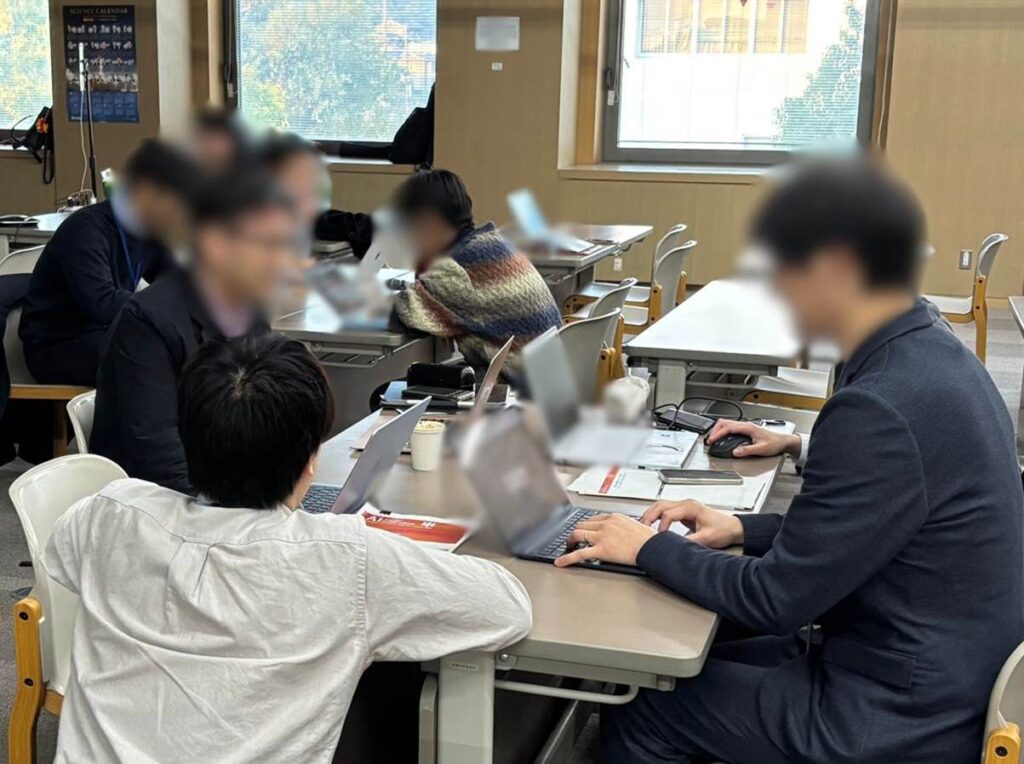
Participants first received an explanation of the Matlantis operating screen and learned how to operate it. Next, they used examples (sample codes) within Matlantis to try out basic operations such as energy calculations, molecular dynamics calculations, and reaction path searches (NEB calculations). There were gasps of amazement at the speed at which calculations that would normally take hours or days could be completed in an instant.
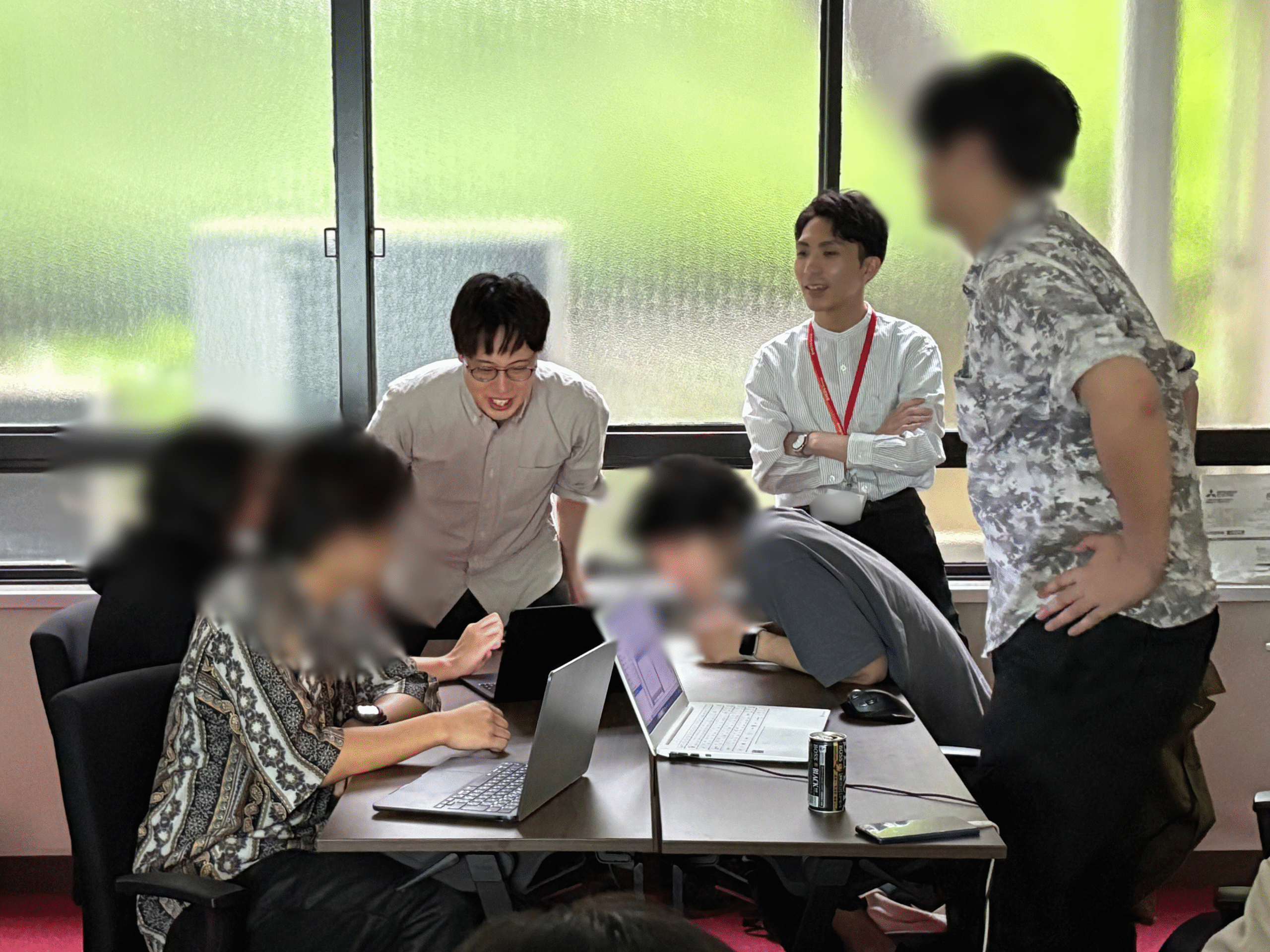
Next, the students moved on to the main theme of the practical portion. Each group formulated a hypothesis: "What kind of structure can efficiently adsorb and desorb CO2?" and designed molecular structures on Matlantis. A wide variety of ideas based on basic chemistry were floated around, such as "Since this is CO2 adsorption, can't we use amide groups?", "Perhaps the parts of MOFs (metal-organic frameworks), the subject of this year's Nobel Prize in Chemistry, will provide a clue," and "We want to effectively adsorb on the plane of a ring structure."
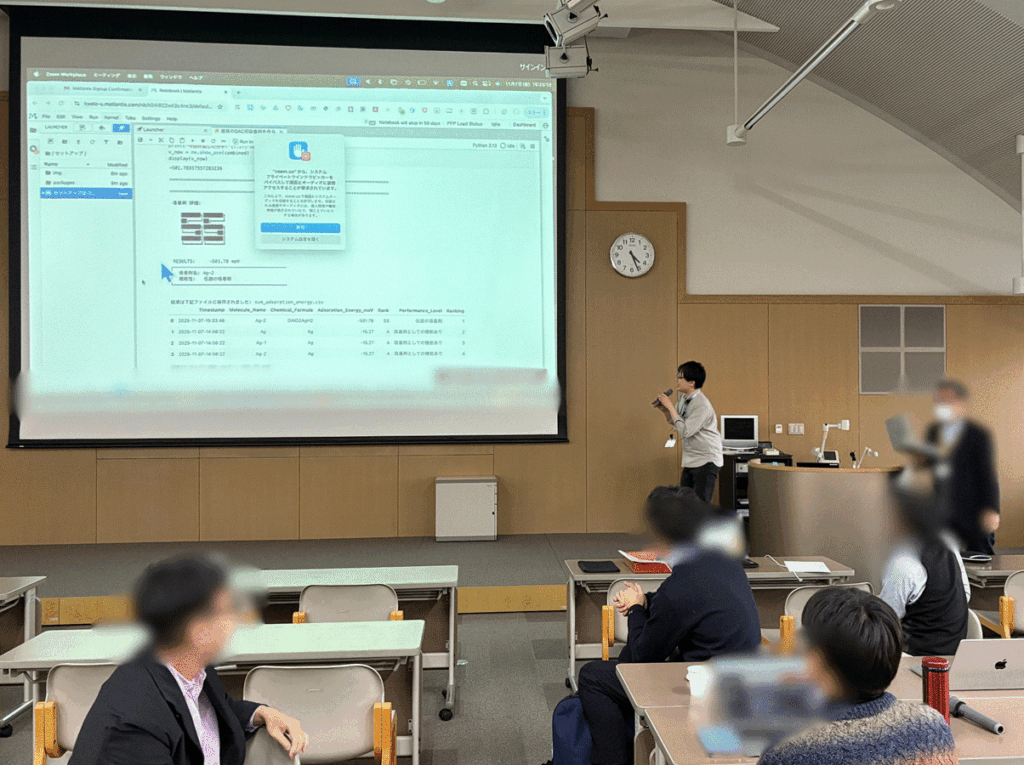
Participants immediately calculated and evaluated their ideas using Matlantis (ranking them SS to C based on adsorption energy *). After looking at the results, they immediately discussed the next strategy and ran the calculations again, repeating a rapid process of trial and error.
The adsorbent that received the highest rating that day was designed by none other than Director Toru Sato of the Kenichi Fukui Research Center. Director Sato's initial design received an "A" rating, but after three or four rounds of refinement, using Matlantis to instantly check the structure and energy, he quickly arrived at a structure that received an "SS" rating. This was a symbolic moment, combining the deep insights of theoretical chemistry with the power of Matlantis, which allows for instant verification.
*The evaluation criteria are based on previous research and are unique to Oba, and do not represent the practicality of the actual adsorbent.
Participant's comments: "This will change the way computational chemistry is done"
The participating students and corporate researchers provided many comments that highlighted the potential of Matlantis.
● "I was surprised at how much faster Matlantis's calculation speed was than I had imagined. Even during this short workshop, I was able to try out ideas and perform calculations multiple times, which is likely to change the way computational chemistry is conducted."
● "Considering this calculation speed and the ability to handle larger systems than conventional quantum chemical calculations, I felt that I could broaden my own research themes."
● "Seeing the calculation results immediately displayed during group discussions gave me a concrete image of engineers discussing things around Matlantis at an actual materials development site."
Summary: Fundamental chemistry and AI pave the way for the future of materials development
This course provided a concrete example of how the overwhelming speed and versatility of AI simulations have the potential to fundamentally transform the materials discovery process.
This course combined the Kenichi Fukui Center's knowledge of "basic chemistry" with ENEOS's promotion of "industrial applications of AI." It was a fascinating experience in which all participants realized how powerful AI simulation technology can be in solving global issues like DAC. Matlantis will continue to support the acceleration of research and human resource development in both education and industry.
-


 URL
URL
Copied
Latest Articles
NEW
Explainer : Why Did the AI Predict That ? Uncovering Atomic-Level Interpretability through PFP Descriptors and Shapley Values

Materials Informatics Explainer computational chemistry

NEW
Writing SMILES from scratch
Explainer computational chemistry
Nagoya University × Matlantis Case Study:“Advanced Experiments for Frontier Technologies and Sciences” —A Four-Day Intensive Course That Sparked Experimental Students’ Curiosity Through AI Simulation
Interview computational chemistry
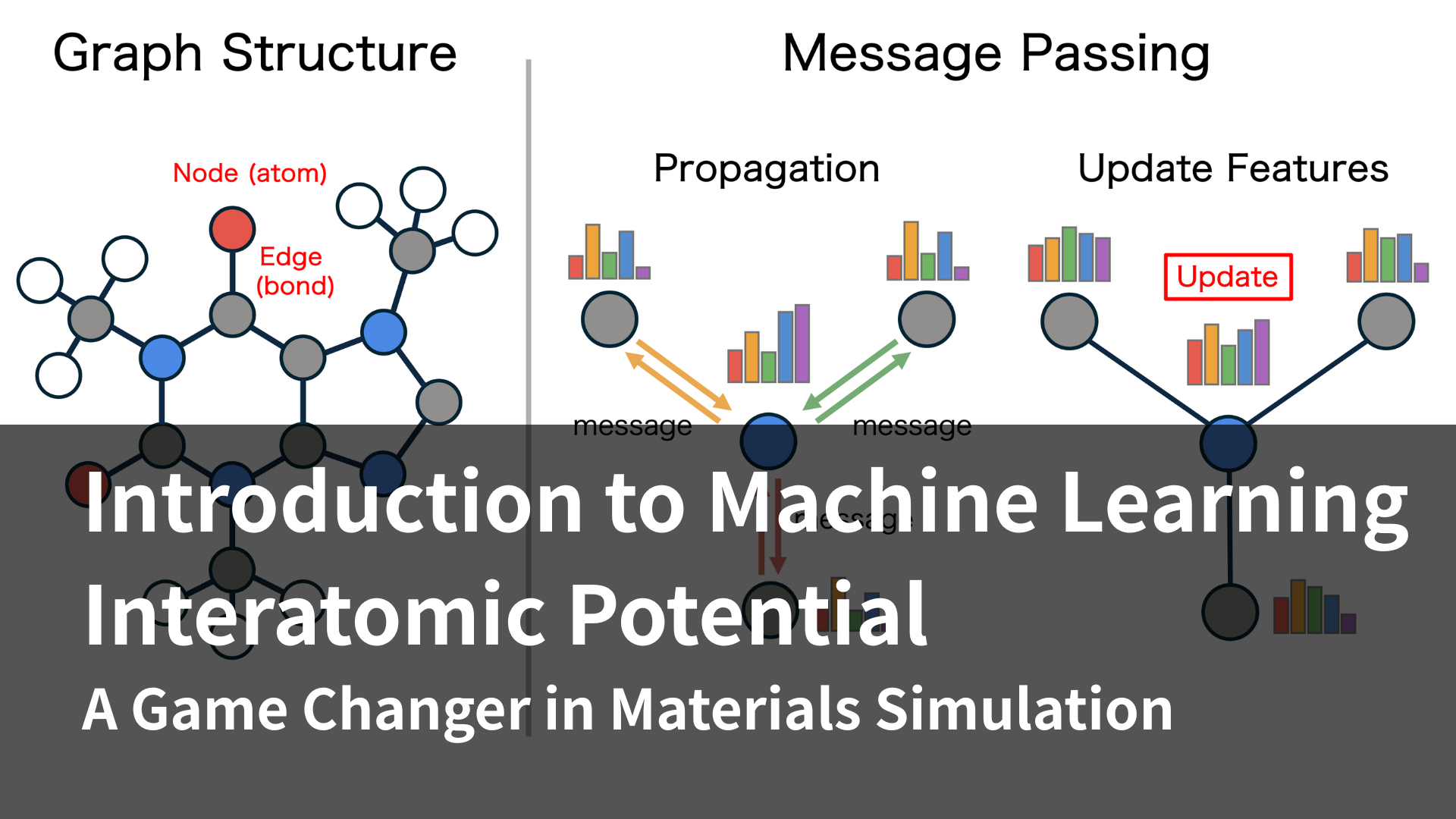
Introduction to Machine Learning Interatomic Potentials (MLIPs): A Game Changer in Materials Simulation

Machine learning force field Explainer
Matlantis, an AI materials simulation that accelerates research, is taught at the University of Tokyo's SPRING GX lectures. Doctoral students experience AI-based molecular design simulations with ENEOS.
Interview