

DFT calculations are the backbone of computational materials science: highly accurate, but notoriously expensive to run. Machine-learning interatomic potentials were meant to change that. Yet for a long time, each model could only handle a narrow, purpose-built slice of chemistry.
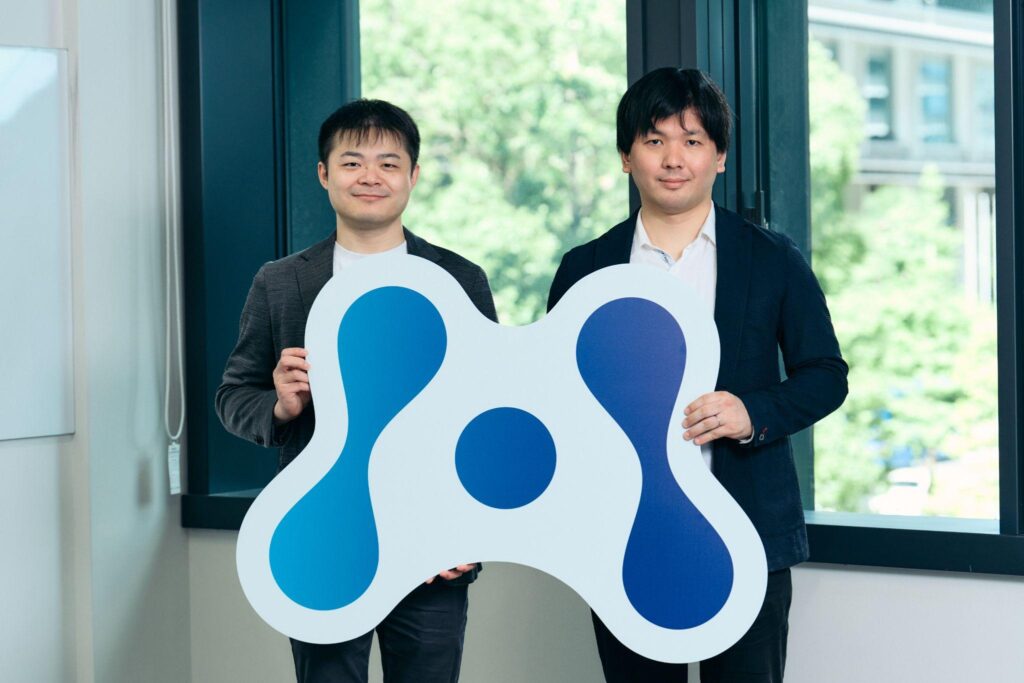
The breakthrough that finally reconciled accuracy with generality is Matlantis PFP, a proprietary AI model with world-leading performance. It is also the engine at the core of Matlantis, our universal atomistic simulator. How did this technology come about? We sat down with So Takamoto and Chikashi Shinagawa, who led the development, to hear the story behind it.
Breaking the "cubic scaling wall": taking on a universal model that everyone said was impossible
— Let's start at the beginning. What was the state of materials simulation before PFP existed?
Takamoto: In one line: there was no such thing as a universal model. Even before PFP, people talked about how much we could unlock if we could simulate the behavior of thousands or tens of thousands of atoms at once.
The problem was cost. To describe atomic behavior accurately, you need to solve the fundamental equation of quantum mechanics, the Schrödinger equation. With the methods commonly used, the amount of computation scales as the cube of the number of atoms.
Multiply the atom count by ten, and the compute time goes up a thousand-fold. Multiply it by a hundred, and you're looking at a million times the cost. However fast supercomputers got, this "cubic scaling wall" made a full solution unreachable in any practical timeframe. In principle the equations could be solved; in practice, we had no way to actually run the calculation.
That meant the ceiling was a "one-off" model tailored to a specific material or phenomenon. Every time you tackled a new material, you had to build a new model from scratch. Simulation could not yet lead materials development, and that frustrating state of affairs lasted for a long time.
— Why take on something that was widely considered impossible?
Shinagawa: The pivotal moment was the start of the ENEOS–Preferred Networks partnership. Working alongside ENEOS, we heard a very concrete need from the field: they wanted to simulate complex reactions on catalyst surfaces. At the time, analyzing the behavior of just a few dozen atoms could easily take six months, a year, sometimes two. That was simply how computational science operated.
Right around then, Preferred Networks put forward an unusual proposition: use machine learning to emulate physics-based calculations. This was still a very early stage; you could handle small molecules made of a limited set of elements like carbon and hydrogen, and not much more. Plenty of voices told us that applying this to systems as complex as catalysts was reckless.
But if it worked, calculations that took years would finish in an instant, and simulation could start to lead experimentation instead of trailing behind it. The dream of turning computational science into a tool people could actually rely on at the bench was the real driving force behind the project.
By design, the AI cannot output what physics forbids
— What does it actually mean to "emulate physics-based calculations with machine learning"?
Takamoto: The standard playbook in machine learning (say, image recognition or NLP) is to let the model learn the rules from data. But for materials simulation, that approach alone has a fatal weakness. A model can look highly accurate on paper, yet the moment you start running an actual simulation, it produces behavior that is physically impossible: atoms fly apart, the structure "explodes."
Physics has rules that cannot be broken. If you keep computing at a "close enough" level of accuracy while ignoring them, errors accumulate, and eventually the tool becomes useless.
That is why we decided to build the laws of physics directly into the neural network architecture itself, rather than treating them as something to be approximated from data. Today this approach is increasingly mainstream, but at the time it was non-mainstream.
— What kinds of physical laws are built into the model?
Takamoto: The most emblematic example is what the field today calls equivariance. Physical laws do not change depending on where the observer stands or how you rotate the material. Scalar quantities like energy stay invariant under rotation of the frame, and vector quantities like forces rotate consistently with it. At the same time, in chemical bonding, the relative orientation between atoms (the angle at which they connect) carries essential information that must be preserved.
We had to reconcile these mathematically: fully equivariant to global rotations of the frame, yet faithful to the internal geometry between atoms. Using higher-order tensor representations, we built our own scheme that guarantees this behavior at the architectural level.
We reinterpreted classical empirical interatomic potentials as a graph neural network, and guaranteed physically correct behavior at the level of the equations themselves. That design, which makes the AI structurally incapable of outputting something that couldn't happen in physics, is the core of what makes PFP trustworthy.
— How were you so certain that neural networks would be such a natural fit for physics simulation?
Takamoto: The real turning point was the deep-learning breakthrough in image recognition around 2012. When neural networks suddenly leapt forward in performance, researchers around the world tried to understand why the AI could interpret images so accurately. What emerged was that the computations inside a neural network share a remarkably similar structure with the computations of physics. The moment I saw that, I was convinced we could use neural networks to build a physics model with real substance.
— A moment where machine learning and physics genuinely converged.
Takamoto: As an aside, I majored in machine learning as an undergraduate, and moved to atomistic simulation for graduate school. At the time they felt like two completely separate worlds, but looking back, having both backgrounds is exactly what let me think across fields and "translate AI into the language of physics." Building new technology often requires that kind of cross-disciplinary expertise.
The AI improves itself, and researchers hand-build the data
— We've heard that PFP has consumed the equivalent of more than 3,200 GPU-years of compute*, just for generating training data (as of the time of this interview). How is such a vast amount of resource actually being used?
*The figure is the total compute required to generate a training dataset of more than 63 million structures, expressed as the number of years it would take on a single GPU.
Shinagawa: In general AI development, most people picture the bulk of the compute going into "training the model." In our case, it's the step before that, running DFT calculations, that is by far the heaviest. Because quantum chemistry cost scales as the cube of the atom count, a single structure can tie up a GPU for several hours; for something complex, a full day is not unusual.
Rather than lean on external databases, we generate this enormous variety of data entirely in-house, and we keep generating more.
— With that much data flowing through the system, is there a mechanism where the AI improves the dataset itself, or hunts down regions where data is missing?
Takamoto: Yes. When you run a simulation with an insufficiently trained model, at some point the behavior goes off the rails. That "broken" behavior is exactly the AI's blind spot: a region where training data is lacking. By identifying those regions and reinforcing them, we've steadily raised the floor of accuracy so simulations stay stable.
— So the AI finds its own weak points and deepens its own training.
Shinagawa: With one important caveat: AI-driven automation alone is not enough. In practice, more than 90% of our data is hand-crafted. If you want to faithfully reproduce the phenomena that matter for a specific application (batteries, catalysts, and so on), automated exploration only takes you so far.
Deciding which atomic structures should be listed and calculated in order to reproduce a given phenomenon is, ultimately, the job of a materials science expert. Let the AI surface what's missing; let humans design the data that fills the gap. That hybrid loop is what protects the quality of the dataset.
Building a "tool for professionals" that nobody had ever seen: realizing it as Matlantis
— We'd like to hear about the path from research result to commercial product. What obstacles did you hit while turning this into Matlantis?
Takamoto: The biggest difficulty was that what we were building was, quite literally, a service that did not exist anywhere in the world. With something like a social network, everyone can intuitively picture the finished product. A "universal materials discovery platform" has no reference implementation. What features would actually make users happy? We had to figure it out from scratch.
— So the question of how to define "usable" for a researcher became central.
Shinagawa: Early on, we leaned heavily toward simplicity. We imagined a stripped-down UI: upload a structure file, press an "Optimize" button, and get results back. But as we kept discussing it, a nagging sense of "no, this isn't right" grew stronger.
— Where did that discomfort come from?
Takamoto: The more deeply we looked at who our users really were, the clearer it became: they didn't want an automation tool that walks them down a predetermined path. Simulation is a means of understanding a phenomenon, and the process of trial and error itself carries value. Paring functionality down to the bone, we realized, could actually strip the tool of its value.
Shinagawa: The world of simulation covers an enormous range of use cases. Batteries, catalysts, semiconductors: each field demands different computational methods. Cramming all of that into a single GUI screen is impossible; forcing it would leave you with a shallow tool that can't support serious research. So we deliberately chose the opposite: a platform you can drive freely through an API.
Takamoto: We provide the building blocks (the functions and packages) and leave it to the researchers themselves to decide how to combine and wield them. Being clear that Matlantis is a "tool for professionals" is, I believe, a big part of why the product landed the way it has.
A future where simulation is as ordinary in research as a microscope
— More than 150 companies and organizations now use Matlantis (as of this interview). Are there episodes where user feedback sharpened the technology?
Takamoto: Too many to count, but the emblematic one is phonon accuracy: how faithfully the model captures atomic vibrations. Shortly after the product launched, around 2022, we received a report from some users that the results didn't match the expected behavior.
We immediately opened a detailed investigation, formed our own hypothesis, and began improving the model. In fact, "phonon accuracy" is a deep, universal issue for machine-learning potentials in general. Competitors and academic conferences only really started to discuss it around 2025. Because we heard it from the field first, we ended up getting a handle on the problem several years ahead of the curve.
— So the field surfaced the issue for you, and you cleared it ahead of your competitors.
Shinagawa: Another example is our current move to adopt a new calculation method called r2SCAN. That, too, started with user feedback. Until now, simulation has been judged largely by how closely results match the training data. But as our user base broadened, a different kind of gap became visible: the numbers matched the calculations, but they didn't always match the experimental values.
Digging into it, we found the issue wasn't the AI's accuracy; it was the physical approximation used to generate the training data in the first place, which was hitting its own ceiling. From the standpoint of machine-learning orthodoxy, changing the conditions of your training data partway through raises the risk of higher error rates, and is normally something you avoid. But what customers really want isn't "the right answer inside the computer"; it's agreement with the real world. So we made the bigger decision: shift to r2SCAN, a more physically faithful method.
— A change driven by taking customer problems seriously. Finally, could you share your visions for the future that PFP and Matlantis will make possible?
Shinagawa: My dream is for Matlantis to become a piece of "standard infrastructure" for materials research. The way experimental scientists today naturally reach for X-ray diffraction, I want anyone entering materials development to first run a simulation as one of their basic tools, and use it to narrow down the options. I hope that becomes the default.
Takamoto: I feel exactly the same way. As long as "adopting simulation" is still newsworthy, it means it's still a specialized technology. When you set out to develop a new material, first you buy a microscope, then you bring in Matlantis. I want it to feel that ordinary, and to build the soil in which the next generation of breakthrough materials will grow.
tag
-


 URL
URL
Copied
New Articles
NEW
Benchmarking Matlantis-PFP v9 on MLIP Arena (full version)
NEW
Introducing Matlantis-PFP v9: Benchmarking on MLIP Arena and Improving Experimental Agreement with r2SCAN
NEW
How to Choose Molecular Dynamics (MD) Simulation Software: 6 Key Points and 14 Tools Compared

Molecular Dynamics Explainer

[Presentation Report] Tokyo University of Agriculture and Technology Doctor's Café #37 & AI Salon #14
Conference Report
![[Presentation Report] Tokyo University of Agriculture and Technology Doctor’s Café #37 & AI Salon #14](https://matlantis.com/wp-content/uploads/2026/07/tuat-doctors-cafe-37-ai-salon-14-1.jpg)
Micro-Physical AI: Another invisible form of physical AI and the future of materials development

CEO Blog