2026.8.4
[Presentation Report] Tokyo University of Agriculture and Technology Doctor's Café #37 & AI Salon #14
"Interdisciplinary Innovation Driven by AI: A Challenge Towards Sustainable Materials Development"
Event details:https://en.tuat-flourish.jp/topics/event/3225/
On July 22, 2026, Fumio Horino (VP of Marketing) and Yusuke Asano (VP of Tech Solution) from our company spoke at "Doctor's Café #37 & AI Salon #14" (Koganei Campus, Green Hall), hosted by the Tokyo University of Agriculture and Technology's FLOuRISH Institute. The theme was "Interdisciplinary Fusion Innovation through AI: A Challenge to Sustainable Materials Development." A wide range of people from various fields participated, mainly doctoral students who are SPRING/BOOST Fellows, and the lecture and panel discussion were conducted in English (Q&A was in English and Japanese).
In the first half of the session, Horino gave a lecture titled "Interdisciplinary Leaps - How AI is Changing the Form of Materials Discovery," in which he outlined how AI simulations are changing the form of research in materials development that holds the key to a sustainable society, such as batteries, catalysts, and semiconductors, and encouraged doctoral students by saying, "Frontiers await those who cross disciplines."
Social Implementation of General-Purpose Atomic-Level Simulators: Diversifying Challenges and Future Human Resources (Asano)
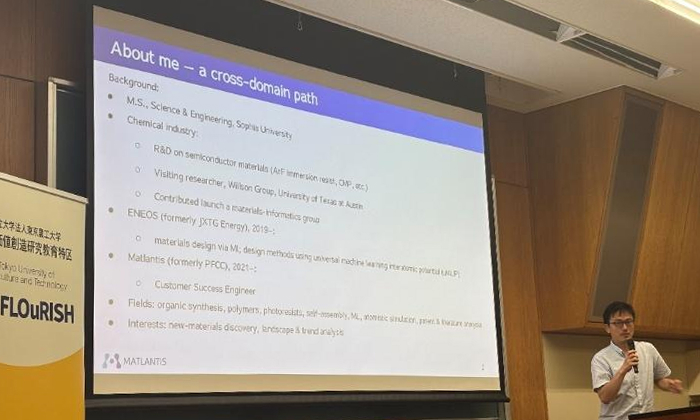
Asano's lecture in the second half began with a description of his own "cross-disciplinary career." From R&D in semiconductor materials (ArF immersion resist, CMP, etc.) at a chemical manufacturer, to a visiting researcher position at the Willson Group at the University of Texas at Austin, to establishing a materials informatics organization at ENEOS, materials design using general-purpose machine learning potential, and finally to becoming a customer success engineer at Matlantis—his journey, spanning fields from organic synthesis to polymers, machine learning, and patent and literature analysis, is a living example of the "interdisciplinary integration" theme of this lecture.
In his lecture, he used Christensen's "Innovator's Dilemma"—the idea that successful companies that pursue the needs of existing customers are often defeated by newcomers who embrace technological shifts—as a starting point to explain the social implementation journey of Matlantis, which was born from the technological shift of deep learning. He spoke about how they accumulated know-how by releasing the product to the market early and continuously improving it based on customer feedback, and how the simple act of reading papers, researching the market, and talking to people every day to identify needs and opportunities is what leads to the next step.
Panel discussion
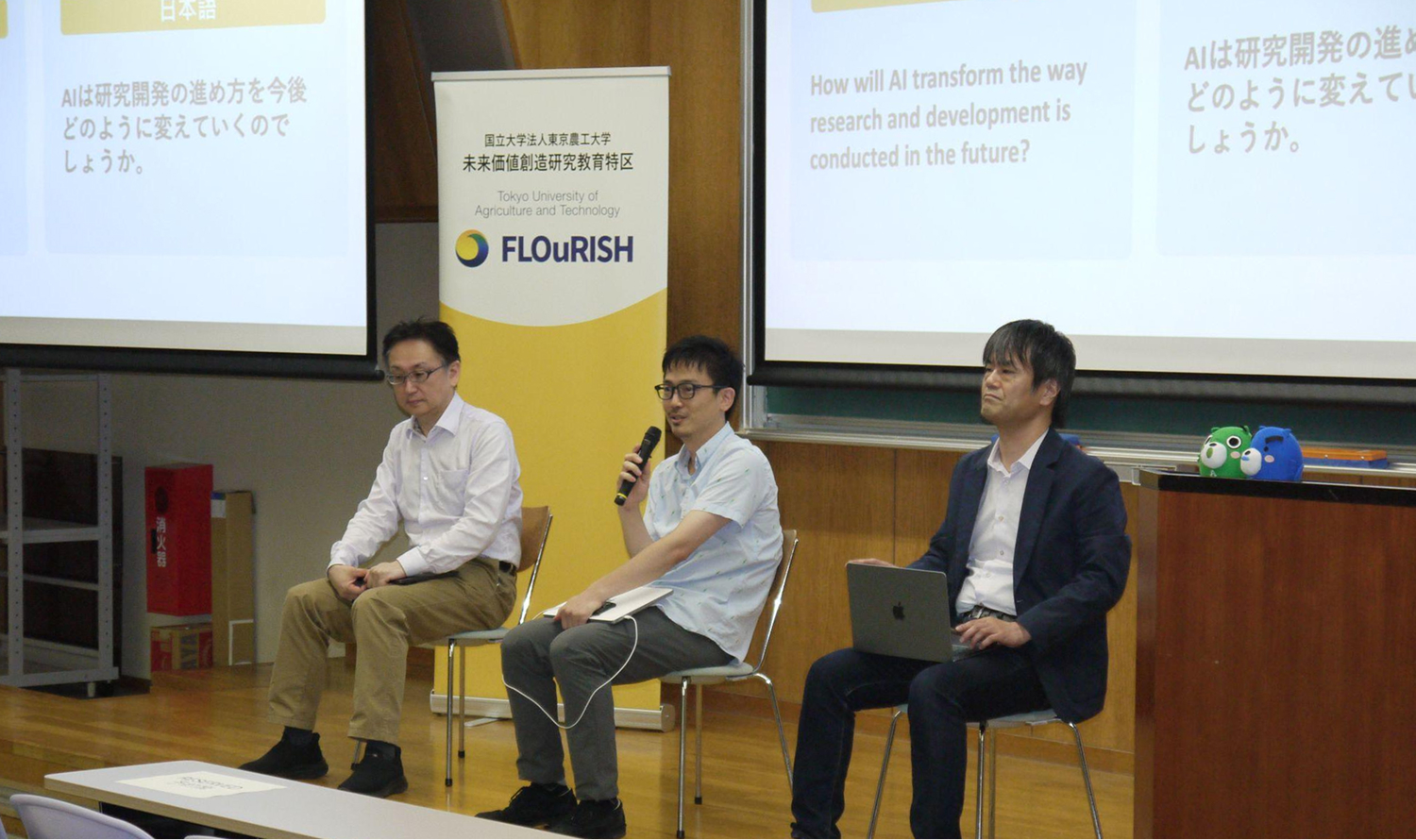
In a panel discussion that included Professor Toshihisa Tanaka of Tokyo University of Agriculture and Technology, the main topic of discussion was "the skills required of researchers, especially doctoral students, in the age of AI." Asano summarized the skills necessary for researchers into three categories: "finding problems/issues, solving problems/issues, and managing them." He stated that while AI provides strong support for the ability to solve problems and issues, the ability to find problems and issues is the area where AI struggles the most, and therefore, it is the core skill that researchers should take on in the future.
In response to a question from the audience regarding the reliability of AI predictions, the concept of confidence intervals in machine learning was introduced. Asano's words, "Research is about making the unknown known and the impossible possible," also served as a powerful message to the students.
Matlantis will continue to collaborate with universities and research institutions to pioneer the future of materials development together with the next generation of research talent.
-


 URL
URL
Copied
New Articles
NEW
Benchmarking Matlantis-PFP v9 on MLIP Arena (full version)
NEW
Introducing Matlantis-PFP v9: Benchmarking on MLIP Arena and Improving Experimental Agreement with r2SCAN
NEW
How to Choose Molecular Dynamics (MD) Simulation Software: 6 Key Points and 14 Tools Compared
Molecular Dynamics Explainer
Micro-Physical AI: Another invisible form of physical AI and the future of materials development

CEO Blog
What is lab automation? Concepts and latest trends in experimental automation in materials development.
Lab automation Explainer