
Webinars
Online2025.9.3 (JPN)
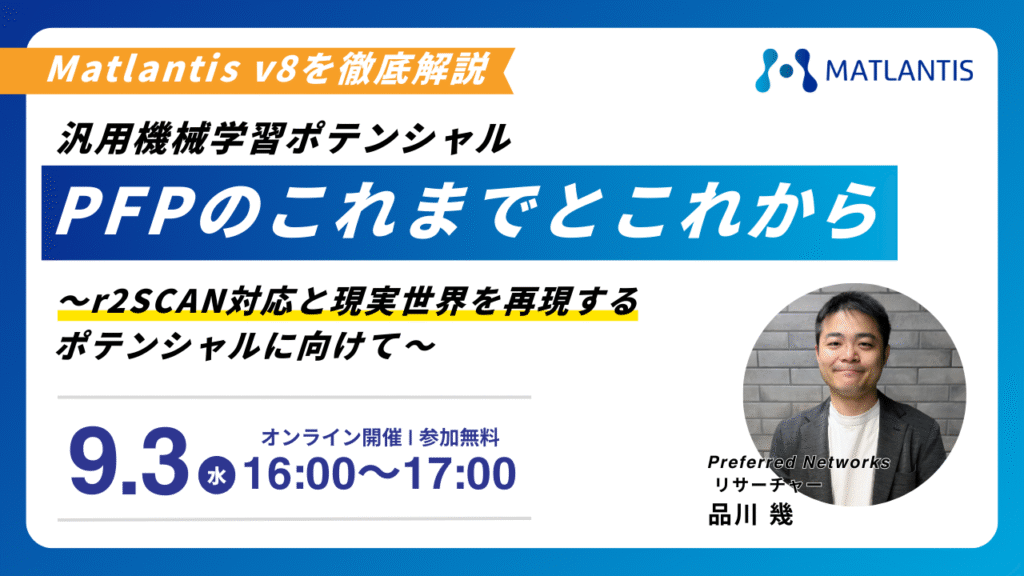
Matlantis Webinar | The Past and Future of PFP: The Potential of General-Purpose Machine Learning - Towards r2SCAN Compatibility and the Potential to Reproduce the Real World -
【Outline】※ This webinar will be conducted in Japanese only.
Matlantis' core technology, PFP, was developed as a general-purpose machine learning potential suitable for materials development and exploration, and is characterized by its ability to reproduce a wide variety of systems, including not only crystals but also molecules and surfaces.
Since the world's first release of PFP v1, which supports 55 elements, in July 2021, the model has been continuously updated, and PFP v7, which supports 96 elements including all elements found in nature, was released in September 2024. This shows the potential for true "versatility" in terms of the number of supported elements.
Then in June 2025, we released PFP v8 with support for the r²SCAN.
The PBE functional used to develop PFP has been widely used in various calculations, but it is known to have issues with reproducibility for molecular systems and transition metal oxides, and PFP was approaching its limits. r²SCAN is attracting attention as a functional with reproducibility that exceeds PBE, and is said to be the next-generation standard.
PFP v8 is trained based on the results of DFT calculations using r²SCAN, and achieves better reproducibility of experimental values than DFT calculations using PBE for crystal formation energies and molecular benchmarks.
The computational cost of DFT using r²SCAN is 3 to 5 times higher than that of PBE, but the major advantage of PFP is that it can achieve higher reproducibility with the same inference speed as conventional methods.
In this webinar,
- Background and technical points of PFP v8's r²SCAN support
- Examples of quantitative improvements in reproducibility
- And the past and future prospects of PFP
The development team will provide more details on this.
【Speakers】
Preferred Networks, Inc.
Chikashi Shinagawa
After completing his master's degree in Chemical Systems Engineering at the Graduate School of Engineering, The University of Tokyo, he worked in research and development at IHI Corporation. In 2019, he joined Preferred Networks, Inc. He specializes in computational chemistry and is responsible for research and development, including the design and collection of datasets for PFP, Matlantis' core technology.

【Webinar Details】
| Date and Time | Wednesday, September 3, 2025 16:00-17:00 (JST) |
| Venue | Online (Zoom) |
| Participation fee | free |
| Target Audience | For Matlantis users and those considering using Matlantis |
| Notes | We may decline your participation in this webinar at our discretion, such as if we receive an application from a competitor. Thank you for your understanding in advance. |
Apply here ※Conducted in Japanese
The event has ended.
公開日:2025.08.13
-


 URL
URL
Copied
New Events and Seminars
NEW
Upcoming events
Webinars
Online2026.03.17(JST)
Identifying Unknown Crystal Structures Prior to Experiments — Designing and Applying Crystal Structure Prediction with Matlantis CSP —

NEW
Upcoming events
Conferences and lectures
Institute of Science Tokyo Ookayama Campus & Online2026.3.15-18
Presented at the 73rd Spring Meeting of the Japan Society of Applied Physics
NEW
Upcoming events
Webinars
Hybrid event held on-site (Akihabara UDX) and online (Zoom)on February 25, 2026
Presentation at the 21st Materials Workshop | The true value and future prospects revealed through the thorough use of Matlantis
NEW
Past News
Webinars
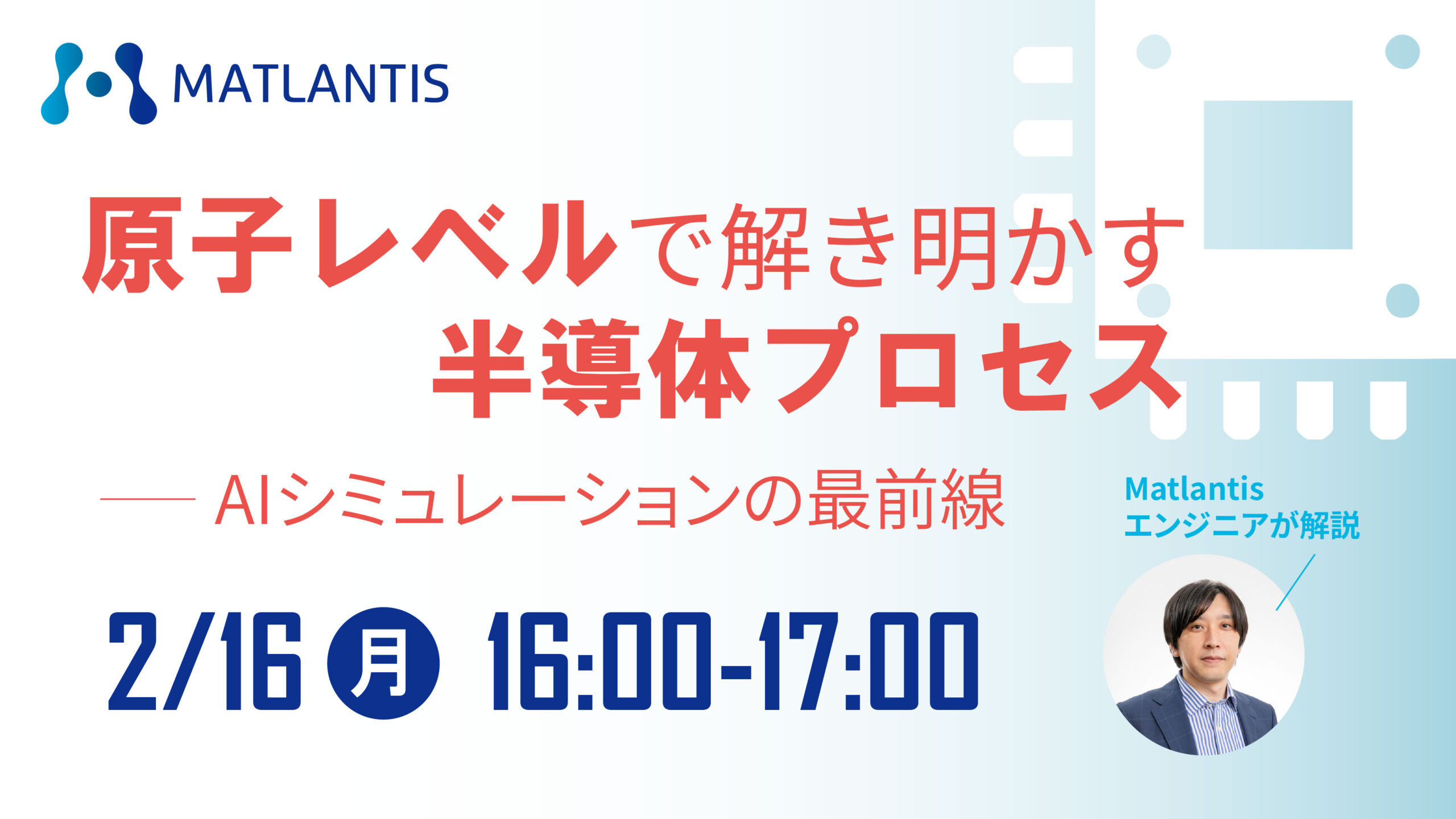
zoom2026/2/16
Matlantis Webinar|Unveiling Semiconductor Processes at the Atomic Level~The Cutting Edge of AI Simulation~
Video Streaming
Webinars
OnlineOn-Demand
[On-Demand Webinar] Matlantis: Universal Atomistic Simulation for AI-Driven Materials Discovery

