
Blog
We provide easy-to-understand explanations of Matlantis terminology and the latest technology trends from an expert's perspective. We deliver information that will help you solve your problems and make new discoveries.
Editor’s PICK
Explainer : Why Did the AI Predict That ? Uncovering Atomic-Level Interpretability through PFP Descriptors and Shapley Values

The online proceedings for the Spring Meeting of the Japan Society of Applied Physics have been published, and it feels like the academic conference season has finally arrived. I'm sure there are many people who have submitted their proceedings and are busy preparing their presentations, and many others who are looking at the published proceedings and planning to attend. At the 86th Autumn Meeting of the Japan Society of Applied Physics last year, I gave a presentation entitled "Interpretation of predictions at the atomic level by combining PFP descriptors and Shapley values."
Materials Informatics Explainer computational chemistry
Writing SMILES from scratch
With the spread of materials informatics (MI), DFT calculations, and molecular dynamics simulations, the number of opportunities to input molecular structures on computers is rapidly increasing. In these cases, the SMILES (Simplified Molecular Input Line Entry System) notation, which treats molecular structures as character strings, is often used. Many chemical software programs allow you to input molecular structures and SMILES.
Explainer computational chemistry

Nagoya University × Matlantis Case Study:“Advanced Experiments for Frontier Technologies and Sciences” —A Four-Day Intensive Course That Sparked Experimental Students’ Curiosity Through AI Simulation
Nagoya University's Graduate School of Engineering's "Cutting-Edge Science and Engineering Experiments" for the second half of the 2025 academic year included a chemical simulation experiment class incorporating the AI atomic-level simulator "Matlantis." By utilizing the power of AI simulation, the quality and speed of research can be dramatically improved. Experimental students who are not experts in computational chemistry experienced this potential with their own hands.
Interview computational chemistry

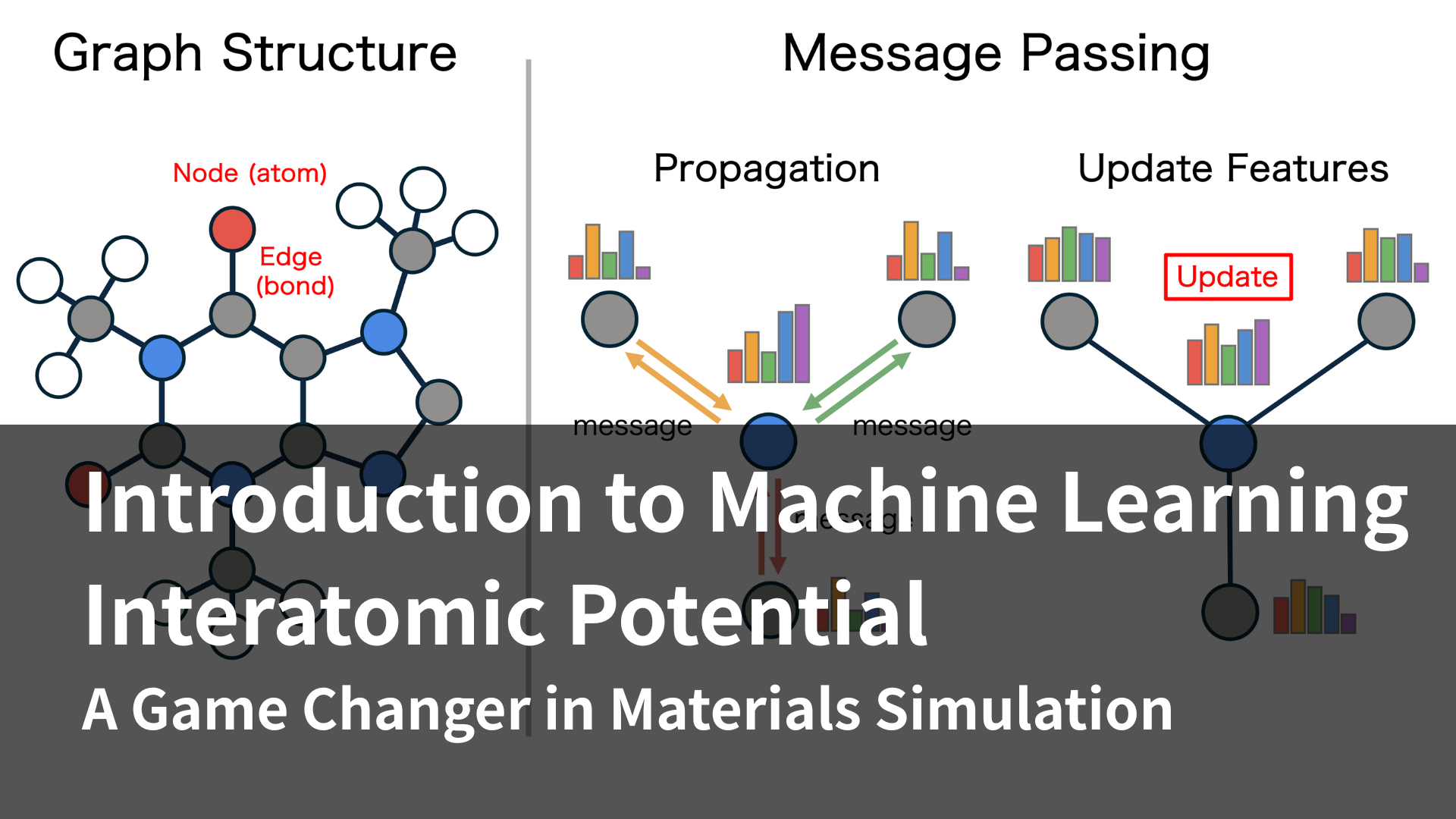
Introduction to Machine Learning Interatomic Potentials (MLIPs): A Game Changer in Materials Simulation

Introduction In the fields of materials science, chemistry, and drug discovery R&D, atomic and molecular level simulations have become established as a fundamental technology for elucidating the properties and reaction mechanisms of materials from a microscopic perspective. However, full-scale application in R&D has always been hindered by the trade-off between "accuracy," "computational cost," and "versatility." For example, first-principles calculations are quantum
Machine learning force field Explainer
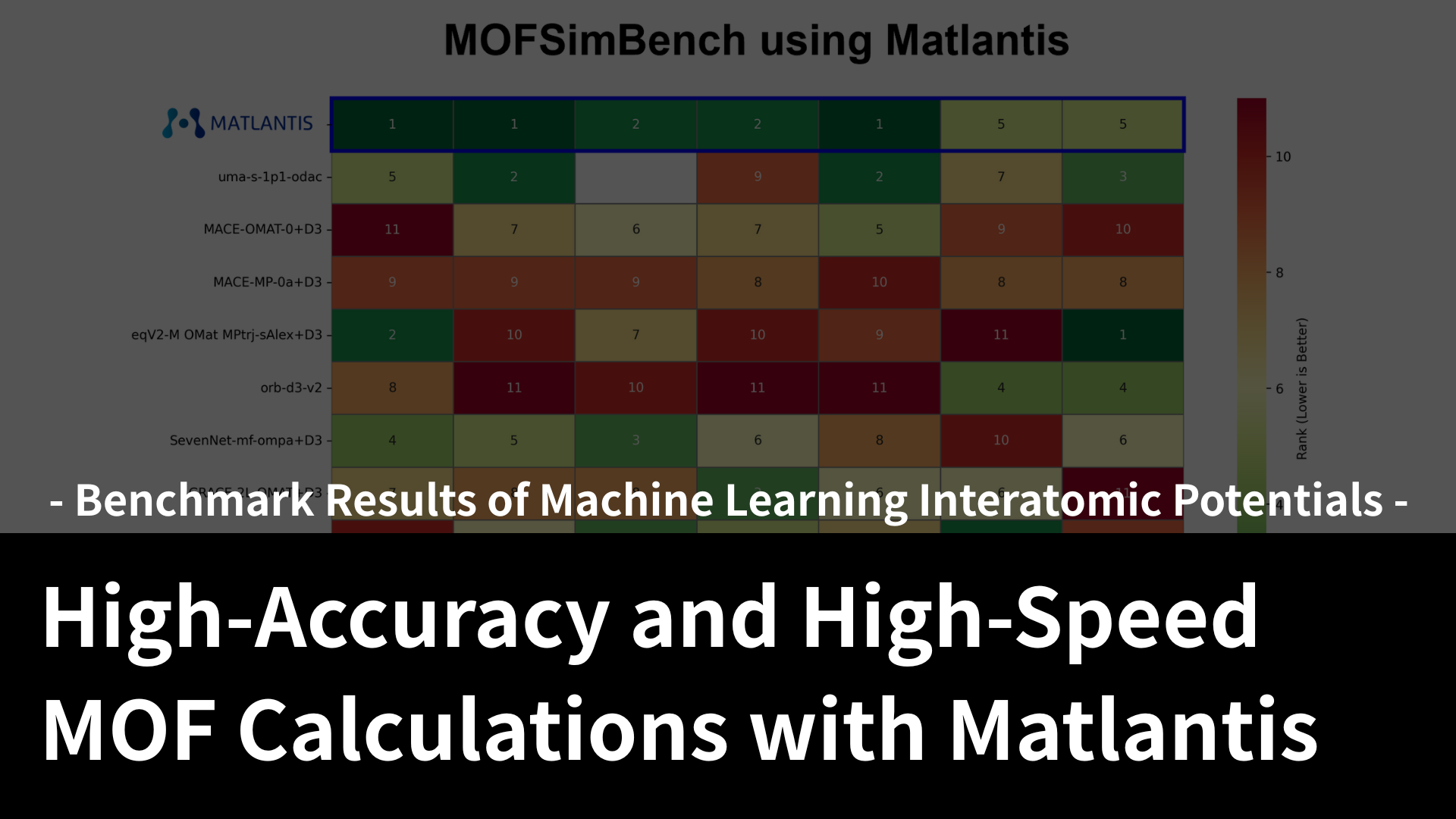
High-Accuracy and High-Speed MOF Calculations with Matlantis - Benchmark Results of Machine Learning Interatomic Potentials -

Matlantis can calculate a wide range of materials, but among them, metal-organic frameworks (MOFs) are important materials with a wide range of applications, including catalysts and CO2 storage. This material, discovered in the 1990s, has already been industrialized and is attracting attention worldwide as an essential material for maintaining a sustainable society. In fact, the 2025 Nobel Prize
Explainer computational chemistry
Featured Tags
Blog article list
[Event Report] Exhibited and presented at ACS Fall 2025
Conference Report
![[Event Report] Exhibited and presented at ACS Fall 2025](https://matlantis.com/wp-content/uploads/2025/08/title-image-scaled.jpg)
[For Beginners] What is Density Functional Theory (DFT)? | Basics

DFT Explainer computational chemistry
![[For Beginners] What is Density Functional Theory (DFT)? | Basics](https://matlantis.com/wp-content/uploads/2025/08/top_eyecatch-01-scaled.jpg)
Molecular Dynamics Simulations for Materials and Molecule Discovery - From Fundamental to Emerging Trends-
MD Explainer computational chemistry

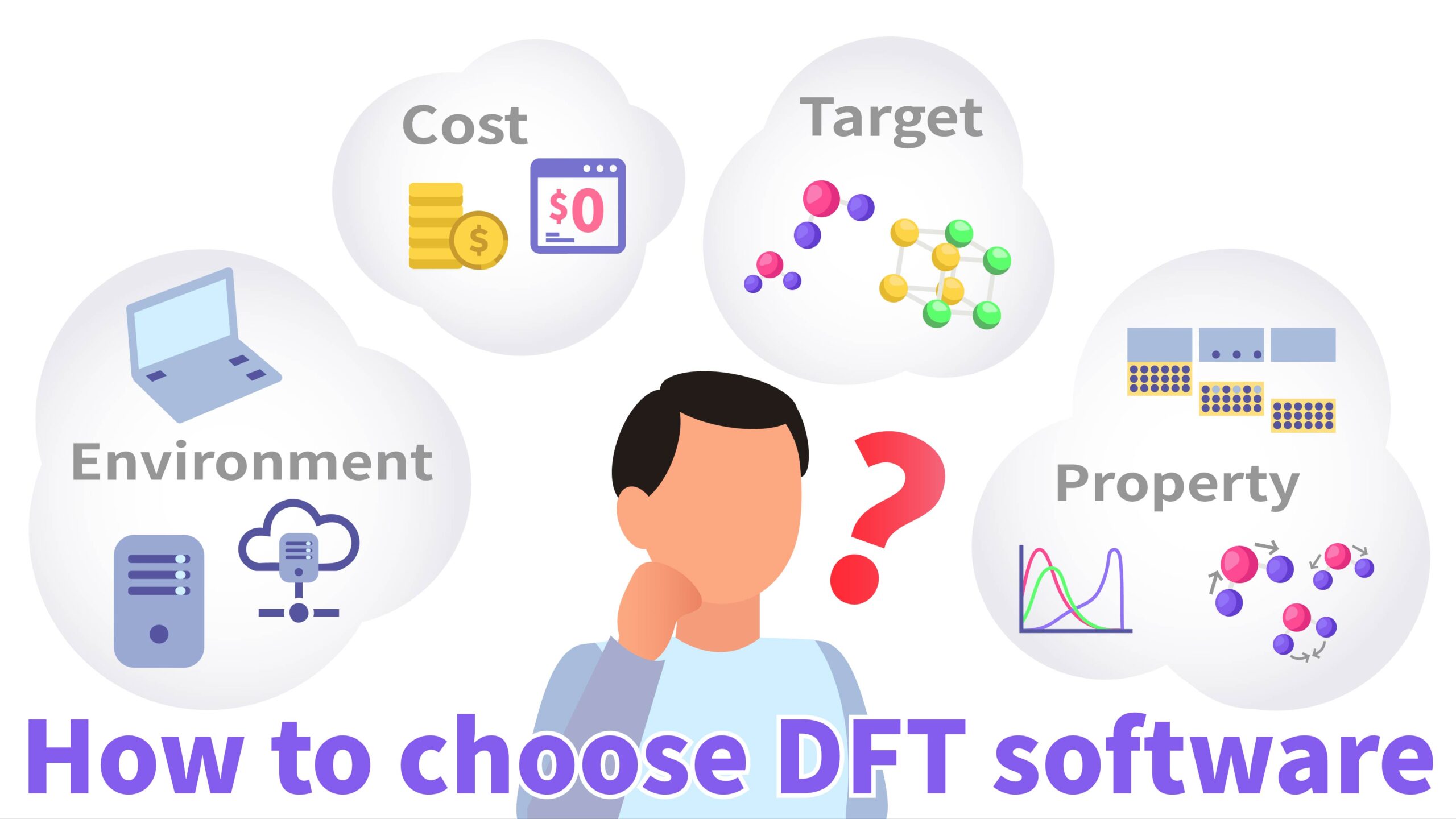
How to Choose DFT Software: Representative Software by Application and Implementation Steps
DFT Explainer computational chemistry
An Introduction to Materials Informatics: From Fundamental Concepts to Cutting-Edge Research.
Materials Informatics Explainer computational chemistry
Accelerating free energy calculations using molecular dynamics with the MN-Core 2 deep learning processor

Free energy estimation using a diffusion model
Development of excited state neural network potential
Application of deep learning to chemical reactions
GraphNVP
Cheminformatics Bioinformatics Drug Discovery
High-speed X-ray crystallography using PFP
Materials informatics crystal structure prediction
High-speed crystal structure prediction using PFP and development of its efficient algorithm
Materials informatics crystal structure prediction
-


 URL
URL
Copied
