


From March 15-19, 2026, the TMS 2026 Annual Meeting was held in San Diego under clear skies, bringing together thousands of materials scientists and engineers to share the latest research findings. Our Matlantis team also joined the circle of over 4,000 participants and presented our research results. Attending numerous sessions and directly interacting with leaders who are driving the materials modeling community was an extremely valuable experience. From the keynote speeches to casual conversations during coffee breaks, there was a consistent theme that resonated throughout the entire venue: "Computational science and artificial intelligence (AI) are playing a central role in rapidly advancing materials research."
More and more, researchers are pairing physical understanding with large datasets and computational models, along with AI-enabled agents and automated research workflows to accelerate discovery. In practice, this shift is reflected in the growing interplay between Matter, Data, Models, and Autonomous Agents. Within this evolving landscape, atomistic simulations are becoming a key tool for discovering and designing new materials earlier in the R&D pipeline.
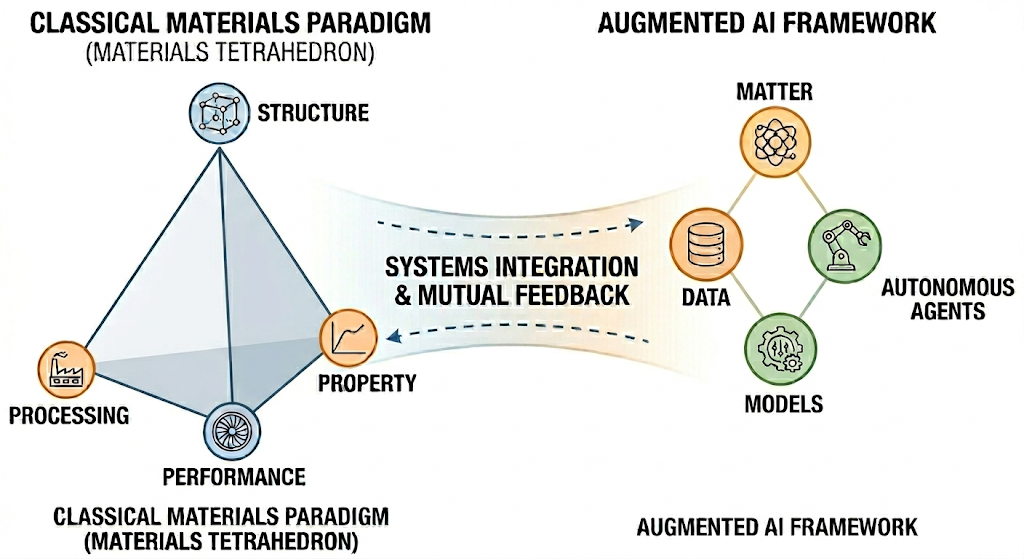
Against this backdrop, a few computational trends came up consistently throughout the conference. Here are three that stood out to us, and how Matlantis fits into them.
Trend 1: The Industrialization of MLIPs and "Atoms-to-Engines" Workflows.
The conversation around Machine Learning Interatomic Potentials (MLIPs) has decisively shifted from "do they work?" to "how do we integrate them into production?" Many presentations highlighted how MLIPs are easing the "A-C-T tradeoff;" that is, the historical compromise between accuracy, cost, and transferability.
aerospace companies to national labs are actively embedding universal potentials into automated multiscale pipelines, utilizing an "atoms-to-engines" approach to evaluate material candidates for properties like thermal expansion, fracture toughness, and complex dislocation behaviors.
Where Matlantis Fits In: As Integrated Computational Materials Engineering (ICME) becomes the industry standard, seamless computational pipelines are becoming ever more important. Matlantis’s cloud-based platform is designed to naturally complement these workflows by providing scalable access to high-fidelity atomistic calculations. By delivering DFT-level accuracy at high speeds, our pre-trained universal machine learning interatomic potential (PFP) can be used to quickly generate the data needed for larger-scale continuum, phase-field, and finite-element models. In that sense, it helps make “atoms-to-engines” workflows more practical in day-to-day use.
Trend 2: AI Realism and Physics-Informed Thermodynamics.
The materials community is now shifting towards a more pragmatic use of AI. There is a growing recognition that simply predicting a stable crystal structure doesn't guarantee the material can actually be synthesized. As a result, researchers are moving away from brute-force computational screening and instead pairing data-driven methods with physical intuition.
This involves strategies like extracting meaningful physical descriptors to train AI surrogate models, or pushing the boundaries of finite-temperature thermodynamics. Rather than evaluating properties at absolute zero, the focus is shifting to dynamic calculations of free energies and temperature-dependent kinetics to better reflect real-world material performance.
Where Matlantis Fits In: Capturing these critical finite-temperature effects and extracting complex physical descriptors requires extensive configurational sampling through Molecular Dynamics (MD), a task that is prohibitively slow and expensive using traditional DFT. Matlantis addresses this bottleneck by combining the speed of classical methods with the accuracy of quantum mechanics. This makes it practical to routinely simulate complex finite-temperature behaviors, allowing researchers to generate the robust, physically grounded data needed for AI-driven discovery frameworks.
Trend 3: Scaling Simulations for Advanced Manufacturing and Extreme Environments.
Simulations are increasingly stepping in where experimental testing is too costly, slow, or restricted by regulations. At TMS 2026, we saw a major focus on nuclear materials, and MLIPs are beginning to play a major role in the modeling of phenomena like defect formation and radiation damage. Alongside this, there was a notable surge in computational modeling for Additive Manufacturing (AM) qualification. For both extreme energy applications and AM, researchers are zeroing in on complex interfacial behaviors like hydrogen diffusion, oxide defect migration, and predicting how printed microstructures hold up or degrade over time in service.
Where Matlantis Fits In: Modeling complex, multi-component alloys or material behavior under harsh conditions typically requires parameterized empirical potentials that fail outside their narrow training sets. Matlantis overcomes this barrier with our universal MLIP, PFP. Whether screening alloying elements for oxide dispersion strengthened steels or exploring grain boundary degradation in AM parts, Matlantis enables rapid exploration of vast chemical spaces and extreme conditions without the expensive overhead of custom model development.
Looking Ahead
The innovations showcased at TMS 2026 point to a clear trajectory: computational materials design is moving past the initial hype phase and maturing into a highly predictive, physics-informed, and inherently multi-scale discipline. As this AI-driven landscape continues to evolve, our focus at Matlantis is to provide the foundational atomistic simulation tools needed to support it. By grounding these advanced workflows in reliable physics, we look forward to helping the community tackle the next generation of complex materials and manufacturing challenges.
Related Links
- Matlantis Portable Guide: Please check out the Matlantis service overview and customer case studies for more detailed information.
- Comprehensive Survey of Computational Science Applications in Materials Science: This report provides a deeper analysis of the trends in computational chemistry for formulating R&D strategies.
-


 URL
URL
Copied
New Articles
NEW
The front runner of AI for Science – A Report from the "Matlantis User Conference 2026"

Conference Report

Changing the rules of materials development with Physics-Grounded AI: how Matlantis PFP came to be

Interview
Benchmarking Matlantis-PFP v9 on MLIP Arena (full version)
Introducing Matlantis-PFP v9: Benchmarking on MLIP Arena and Improving Experimental Agreement with r2SCAN
How to Choose Molecular Dynamics (MD) Simulation Software: 6 Key Points and 14 Tools Compared

Molecular Dynamics Explainer