
The ultimate goal of R&D DX (Digital Transformation) in the materials field is to "develop products that meet market needs in a shorter timeframe." There are various ways to achieve this goal, but one of the most important is "accelerating the exploration cycle (hypothesis formulation → candidate selection → verification → result interpretation → ...)."
Accelerating each step of the exploration cycle allows for quicker identification of potential materials, reducing wasted trial and error, and faster identification of failure causes to determine the next experimental strategy. This article focuses on this "accelerating the exploration cycle" and explains the challenges that arise in the field and how to solve them.
What is R&D DX in the field of materials science?
R&D DX in the materials field is a broad concept that includes the development of data infrastructure, the development of core technologies, and the digitalization of operations. For example, the Cabinet Office website lists initiatives such as creating an environment to promote the management and utilization of research data, developing research infrastructure, and fostering research communities as part of "Research DX" [1].
This article will organize research and development DX in the materials field from the following three perspectives.
- Digitalization of research environment and research operations: Establishing a research infrastructure through digitalization.
- Building a foundation for utilizing research data: Creating an environment where data can be compared, reused, and analyzed.
- Accelerating the exploration cycle: Leveraging data and digital technologies to accelerate the research and development process itself.
Each perspective will be explained in detail below.
Digitalization of research environment and research operations
The first aspect is the digitalization of the research environment and daily operations. Representative initiatives are shown below.
- The introduction of electronic laboratory notebooks (ELNs) digitizes paper laboratory notebooks to improve the searchability, sharing, and quality of experimental records.[2]
- Utilizing a Laboratory Information Management System (LIMS): Centrally managing sample information and measurement data to understand and track the progress of experiments.
- Establishing an internal portal and digitizing procedures: Digitizing workflows for various applications and reports to reduce the burden of administrative work.
By introducing ELN and LIMS, information sharing such as experimental results and conditions becomes smoother, eliminating the reliance on individual researchers for research knowledge and experimental know-how. For example, even if a previous researcher moves to another department or retires, the experimental records accumulated in ELN allow for efficient handover. Furthermore, this centralization of experimental data leads to improved reproducibility of research results and prevents omissions and errors in experimental data.
Building a foundation for utilizing research data
The second perspective is creating a foundation for analyzing and utilizing the accumulated research data. To compare, analyze, and reuse data on ELN and LIMS across multiple systems and projects, it is essential to create a system that standardizes data formats and recording rules throughout the organization [3].
Examples of specific initiatives are shown below.
- Standardizing data formats: Establish a common format for the team or organization, such as CSV, JSON, or a specific schema.
- Metadata preparation: Record experimental conditions (temperature, pressure, pretreatment method), equipment used, measurement date and time, etc., together with the data.
- Design of material/sample IDs: Assigning unique IDs to materials and samples to ensure traceability.
- Considering mechanisms for accumulating and searching data: Building a data infrastructure that suits the organization, such as a database or data lake.
For example, the National Institute for Materials Science (NIMS) provides a data infrastructure for the collection and utilization of materials data as a digital ecosystem called "DICE" [4]. DICE is a concrete example of building a foundation for research data utilization, as it includes mechanisms to support the accumulation and structuring of research data, and mechanisms to make it easier to search and reuse data based on metadata.
Speeding up the search cycle
Finally, there are efforts to accelerate the "exploration cycle," which is at the core of research activities, by utilizing data and digital technologies.
The exploration cycle refers to the research and development process that materials researchers routinely go through. By creating a state where this process can be completed "in a shorter time," it becomes possible to develop target materials more quickly and efficiently.
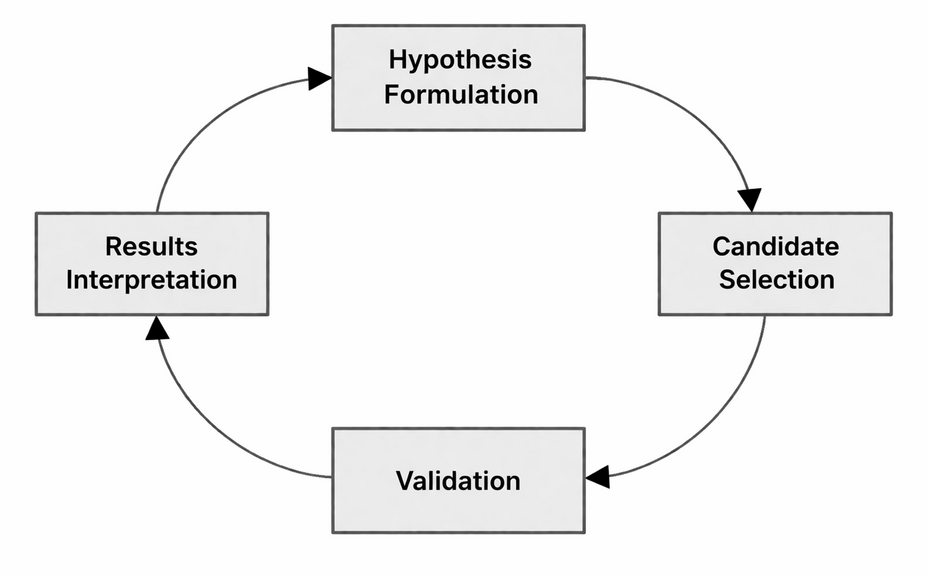
- Hypothesis formulation: Based on past knowledge and theories, formulate a hypothesis such as, "This composition/structure might be good."
- Candidate selection: Based on the hypothesis, narrow down the candidate materials and experimental conditions to be tested.
- Verification: Confirm the physical properties and behavior of candidate materials through synthesis and evaluation.
- Interpretation of results: Analyze the obtained data and consider why the results occurred.
- Next hypothesis formulation: Update the hypothesis based on the analysis and enter the next cycle.
Implementing DX (Digital Transformation) can accelerate decision-making at each stage of the exploration cycle. For example, in the "candidate selection" stage, organizing and making past experimental data and conditions easily accessible allows for quick narrowing down of promising experimental candidates. In the "results interpretation" stage, comparing and analyzing the obtained data in relation to the conditions allows for quick identification of the reasons for success (or failure), leading to the next stage of "hypothesis formulation."
Accelerating each stage of the exploration cycle directly contributes to achieving the ultimate goal of R&D DX: "developing products that meet market needs in a short period of time." This article will focus on explaining how to accelerate this "exploration cycle."
On-site challenges hindering the acceleration of the "exploration cycle" through R&D DX.
In the field of materials development, several bottlenecks exist that hinder the acceleration of the exploration cycle. Here, we will address three challenges that are particularly common in the field.
There are many potential candidates for exploration.
A major challenge in materials development is the large number of parameters that need to be considered, resulting in an enormous number of potential materials.
For example, consider the case of developing a cathode material for a battery. In this case, in addition to the basic composition, many parameters must be considered, such as the substitution ratio of elements, the presence and type of additives, the synthesis temperature, and the firing time. Even just changing the composition of three elements in 10 steps results in 1000 combinations. If you add variations in additives, synthesis temperature, firing time, etc., the number of candidate materials will increase rapidly.
It is difficult to cover such a large number of material candidates with conventional experiments alone, and researchers are forced to narrow down the candidates to actually synthesize based on experience and intuition. However, in this case, there is a risk of missing promising candidates or of development being prolonged because it is difficult to find the optimal material.
The experiment takes time.
Experiments in materials development are often time-consuming. Material synthesis itself can take several days to several weeks, in addition to waiting for equipment to be used and time required for evaluation and measurement. For example, evaluating the long-term cycle characteristics of battery materials can take several months or more depending on the conditions.[5]
These physical time constraints can become a bottleneck in the "verification" phase of the search cycle, slowing down the overall cycle.
Interpreting experimental results is difficult.
The performance of a material is determined by a complex interplay of many factors, including interface structure, adsorption behavior, diffusion properties, and the state of impurities. Therefore, even after spending time synthesizing and evaluating candidate materials, it can sometimes be difficult to identify and interpret the reasons behind the results.
For example, in the development of lithium-ion battery materials, the state of the electrode/electrolyte interface greatly affects battery performance, but the formation mechanism of the interface layer is complex, and it is considered difficult to elucidate its effects through experiments alone [6]. In such cases, it becomes difficult to obtain the scientific insights necessary for formulating the next hypothesis, making it difficult to move forward with the exploration cycle.
A means to achieve "accelerated exploration cycles" in R&D DX in the materials field

Even with the challenges mentioned above, this article introduces two effective methods for accelerating the exploration cycle: "Materials Informatics (MI)" and "Materials Simulation."
Materials Informatics (MI)
Materials informatics (MI) is a method that uses past experimental and literature data to train machine learning models on the relationship between "material composition, structure, and process conditions" and "obtainable physical properties," and utilizes this for predicting physical properties and exploring new materials.
The applications of MI can be broadly divided into "prediction" and "exploration." "Prediction" involves using a trained model to estimate what kind of physical properties can be obtained with a given composition and conditions before an experiment. "Exploration," on the other hand, refers to using these prediction results to efficiently select promising material candidates to try next. [7]
Bayesian optimization is a well-known "search" method in MI (Material Informatics). In Bayesian optimization, the next experimental candidate is selected by considering the prediction result and its uncertainty (such as the standard deviation). Then, the machine learning model is updated using the newly obtained experimental data. By repeating this cycle of "search → experiment → model update → ...", it becomes possible to efficiently find materials with the desired physical properties.
If you'd like to learn more about MI and Bayesian optimization, please also check out our blog post, "What is Materials Informatics (MI)? A clear explanation from basic concepts to the latest research."
Advantages of MI
The advantages of MI are the "prediction" of material properties before experimentation and the "exploration" of potential materials to try next. By utilizing "exploration" with machine learning models, it is possible to efficiently narrow down high-priority material candidates and speed up the "candidate selection" process in the exploration cycle.
Of the three challenges in achieving faster search cycles mentioned earlier, this approach is particularly effective in addressing the challenge of having "a large number of potential candidates for exploration." It also indirectly addresses the challenge of "experiments taking too long" by reducing unnecessary experiments, and contributes to the challenge of "difficulty in interpreting experimental results" by enabling the estimation of important factors and visualization of correlations through analysis of pre-trained models.
Challenges of MI
On the other hand, MI also has several challenges.
- Building the database used for training requires significant effort: MI accuracy heavily depends on the quality and quantity of training data. Experimental data often varies in format from project to project, requiring considerable effort just to organize the data.
- Creating high-performance models is difficult: Model building requires expertise in data science, which is sometimes beyond the capabilities of materials researchers alone.
- Predicting outside the learned range is difficult: The reliability of predictions tends to decrease outside the range of the training data (unknown territory).
Material simulation
Material simulation is a general term for methods that use the structure and composition of a material as input to calculate its function and properties based on physical laws. While material intelligence (MI) is a data-driven approach that "predicts relationships based on experimental data," material simulation can be described as a principle-driven approach that "starts from physical laws such as quantum mechanics and classical mechanics."
Materials simulations encompass a variety of methods, ranging from atomic and molecular-level simulations (such as DFT calculations and molecular dynamics) to mesoscale and macroscale simulations, depending on the target scale.[8] For example, atomic and molecular-level simulations can calculate the stability of a defined structure, the movement of atoms, and the pathways of chemical reactions. Adsorption behavior, diffusion properties, and interface stability, which are difficult to observe directly in experiments, can also be estimated.[9]
(Density functional theory (DFT) and molecular dynamics are commonly used methods for simulating materials at the atomic and molecular level. For more detailed information on each, please refer to our blog articles "[For Beginners] What is Density Functional Theory (DFT)? | Basics" and"Introduction to Molecular Dynamics Simulation.")
Advantages of material simulation
The two main advantages of material simulation are as follows:
- Predicting material properties based on principles is possible: Because it is based on physical laws, predictions with scientific basis are possible.
- Contributing to the understanding of phenomena and scientific consideration: Based on simulation results, phenomena and their mechanisms that are difficult to observe directly in experiments can be visualized and understood.
These advantages allow material simulations to accelerate the following steps in the exploration cycle:
- Candidate Selection: Comparison and narrowing down of material candidates through simulation (virtual screening) is possible.
- Interpretation of results: Visualizing and understanding phenomena and their mechanisms that are difficult to observe directly in experiments enables scientific consideration necessary for formulating the next hypothesis.
Of the three challenges mentioned earlier in achieving faster exploration cycles, this approach is particularly effective in addressing the issues of "a large number of potential materials to explore" and "difficulty in interpreting experimental results." Furthermore, conducting material simulations instead of experiments (virtual experiments) directly addresses the issue of "experiments taking too long."
Challenges in materials simulation
On the other hand, material simulations also have the following challenges:
- Atomic-level calculations are extremely time-consuming: DFT calculations, in particular, are computationally expensive, and calculating a single structure can take several hours to several days.
- High burden of hardware preparation and maintenance: High-precision material simulations require high-performance computers and clusters, and their procurement and maintenance require cost and expertise.
[Table Summary] Comparison of Materials Informatics (MI) and Materials Simulation
The characteristics and differences between MI and material simulation, which have been explained so far, are summarized in the table below.
| MI | Material simulation | |
| approach | Data-driven (statistical) | Principle-driven (based on physical laws) |
| Main methods | Bayesian optimization, etc. | DFT calculations, molecular dynamics (MD) methods, etc. |
| Which stage of the exploration cycle is it primarily effective at? | Candidate Selection | Candidate selection, result interpretation |
| Particularly effective tasks | "There are many candidates to search for." | "There are many candidates to explore," and "Interpreting the experimental results is difficult." |
| advantage | It is possible to predict material properties before experimentation and efficiently select promising material candidates. | Predictions based on principles have clear justification and contribute to understanding phenomena. |
| assignment | The effort required to prepare training data is significant, building a high-performance model is difficult, and evaluating areas outside the training scope is challenging. | Atomic-level methods require long computation times and demand high hardware setup and maintenance. |
As such, MI and materials simulation each have their own advantages and disadvantages. Therefore, it is important not to rely on only one method, but to appropriately incorporate both depending on the situation and phase of the research and development.
"Matlantis," an AI-powered atomic simulator that promotes R&D DX.
While the "material simulation" methods discussed in this article enable highly accurate calculations at the atomic level, they also have challenges such as long calculation times and high computation costs. Our company's "Matlantis" is attracting attention as a new approach to address these challenges.
Matlantis is a cloud service that leverages AI to perform highly accurate atomic-level simulations at significantly faster speeds than conventional methods. It overcomes the aforementioned challenges of materials simulation, such as "time-consuming calculations" and "difficult hardware setup," and is characterized by its immediate applicability to a wide range of materials topics.
For specific examples of how to use Matlantis and the benefits of implementing it, please see our customer case studies page.
Summary
This article focuses on "accelerating the exploration cycle," which is particularly likely to yield results in R&D DX in the materials field. It explains three challenges that arise in practice and effective means (MI and materials simulation) to accelerate the exploration cycle even when these challenges exist.
When promoting R&D DX, it's a good idea to identify where the bottlenecks lie in your company's research process and then consider introducing MI (Materials Inspection) or materials simulation.
For those who want to understand the current state of R&D DX and materials simulation: We offer a free research report that will be useful for your work starting tomorrow.
For those who want to easily catch up on the latest trends in R&D DX and materials simulation, we offer free research reports. Please feel free to use them as material for internal presentations and proposals.
This document analyzes over 100,000 research papers to visualize trends in the application of computational chemistry in the materials science field and identify future growth areas. It provides insights useful for selecting research themes and considering methods for promoting R&D digital transformation (DX).
This report analyzes the actual use of AI-driven simulations in materials research and development, based on survey data from 300 experts in materials science and engineering in the United States. It provides insights into real-world challenges and solutions for promoting R&D DX, including the impact of computational resource bottlenecks and methods for balancing speed, accuracy, and reliability.
[References]
[1] Cabinet Office, "Research DX (Digital Transformation)": https://www8.cao.go.jp/cstp/kenkyudx.html
[2] E. D. Foster et al., “Implementing an institution-wide electronic lab notebook initiative”
[4] NIMS Data Center (MDPF), "What is DICE?": https://dice.nims.go.jp/about.html
[7] Matlantis blog, "What is Materials Informatics (MI)? A clear explanation from basic concepts to the latest research": https://matlantis.com/ja/resources/blog/what-is-materials-informatics/
[9] Matlantis blog, "What is Density Functional Theory (DFT) for Beginners? | Basics": https://matlantis.com/ja/resources/blog/dft/
-


 URL
URL
Copied
New Articles
NEW
The front runner of AI for Science – A Report from the "Matlantis User Conference 2026"

Conference Report

Changing the rules of materials development with Physics-Grounded AI: how Matlantis PFP came to be

Interview
Benchmarking Matlantis-PFP v9 on MLIP Arena (full version)
Introducing Matlantis-PFP v9: Benchmarking on MLIP Arena and Improving Experimental Agreement with r2SCAN
How to Choose Molecular Dynamics (MD) Simulation Software: 6 Key Points and 14 Tools Compared

Molecular Dynamics Explainer