
Past News
exhibition
Colorado Convention Center, Denver, CO2024.8.19-21 (USA)
Announcement of participation in ACS FALL 2024
PFCC will exhibit at ACS FALL 2024, which will be held from Sunday, August 18th to Thursday, August 22nd, 2024. Please see below for details of our exhibit.
Exhibition and booth information
Exhibition period: August 19th (Mon) - August 21st (Wed), 2024
Location: Colorado Convention Center, Denver, CO
Booth: 1815
Presentation information
DIVISION : Division of Computers in Chemistry
SESSION: Materials Science
SESSION TIME : 8:00 AM – 11:45 AM (Local time)
Lecture date and time: Tuesday, August 20, 2024 9:30 AM – 9:45 AM
Lecture venue: Hall D – Room 1
Title: Evaluation of a universal neural network potential for applications to non-ideal structures.
overview :
Machine learning potentials are promising techniques for accelerating atomistic simulations for materials development. The Preferred Potential (PFP), integrated into Matlantis™, is a recently developed universal graph neural network (GNN) potential trained on large DFT datasets, which include crystals, molecular surfaces, adsorbates and disordered structures 1. Such comprehensive training enables PFP to be applied to practical applications in diverse areas, including thermodynamic analysis, reaction kinetics, and molecular dynamics simulations. PFP was shown to perform well in predicting energies and forces reproducing results from the PBE functional, which is used as training data, as well as comparison with experiments 1. To ensure the reliable application of universal machine learning potentials, it is crucial to validate their accuracy on involving specific systems and properties, especially those structural imperfections and finite temperatures.
In this study, we have examined the accuracy of PFP for non-ideal structures and thermodynamic properties. Benchmarking of PFP for the grain boundary energies of elemental metals indicate that PFP well reproduces the PBE results. Surface energies for elemental crystals agree mostly well with those of PBE results, while surface energies of transition metals are underestimated. The lower accuracy of these surfaces possibly stem from insufficient training data or from an inaccurate surface magnetism. Specific heat of crystals and organic liquids at finite temperature were modeled using quasi-harmonic phonons and two thermodynamic phase models 2, and the PFP results agree well with experiments. These results demonstrate that GNN potentials trained on large dataset well reproduce the potential energy curve around the local minimum with PBE accuracy.
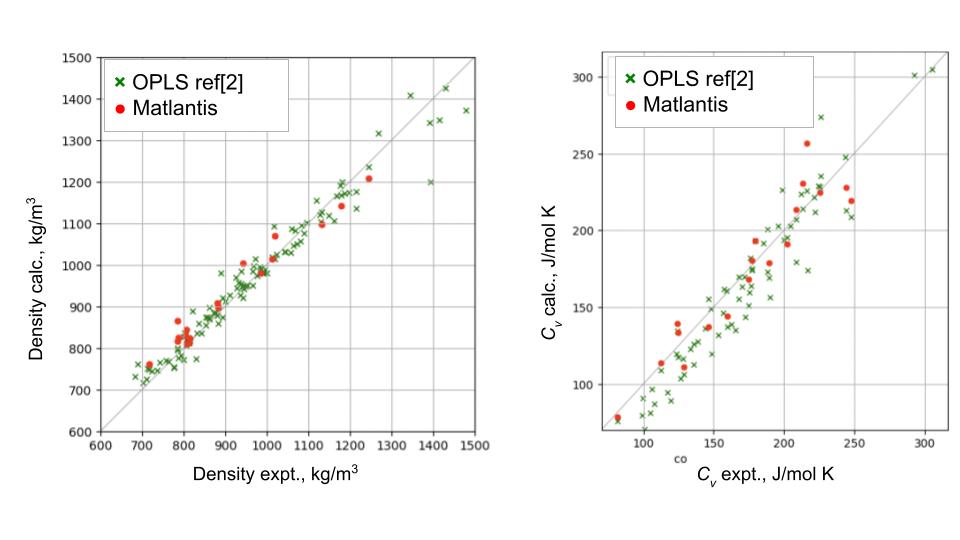
(1) S. Takamoto, et al. Nature Communications 2022, 13, 2991.
(2) C. Caleman, et al. J. Chem. Theory Comput. 2012, 8, 61.
公開日:2024.07.16
-


 URL
URL
Copied
New Events and Seminars
NEW
Video Streaming
Webinars
OnlineOn-Demand
[On-Demand] Unraveling Semiconductor Processes at the Atomic Level

NEW
Upcoming events
Conferences and lectures
Raleigh, North Carolina, USAMarch 10-12, 2026
Presentation at TechConnect World 2026
Past News
Webinars
Online2026.03.17(JST)
Identifying Unknown Crystal Structures Prior to Experiments — Designing and Applying Crystal Structure Prediction with Matlantis CSP —

Upcoming events
Conferences and lectures
Institute of Science Tokyo Ookayama Campus & Online2026.3.15-18
Presented at the 73rd Spring Meeting of the Japan Society of Applied Physics
Upcoming events
Webinars
Hybrid event held on-site (Akihabara UDX) and online (Zoom)on February 25, 2026
Presentation at the 21st Materials Workshop | The true value and future prospects revealed through the thorough use of Matlantis
