
"To contribute to the creation of innovative materials and realize a sustainable world." This is the mission of Matlantis. We believe that the creation of new materials is essential for the sustainable development of humankind, and that to achieve this, it is necessary to accelerate discovery by making full use of the power of computation, including computational chemistry and AI.
The Japanese government also revised its "Strategy for Strengthening Materials Innovation Capabilities" in June 2025, and one of the actions it has set forth is the further promotion of "Materials DX" centered on the utilization of data infrastructure.
So, to what extent are these calculation techniques actually used in materials development? In this article, we will analyze the gaps revealed by our own survey and explore ways to overcome them using numerical data.
Survey Overview
In June 2025, we conducted a web-based survey through an external partner company, targeting engineers and researchers primarily in the manufacturing sector in Japan. Of the 118 respondents, we focused on 82 individuals (from 82 companies) belonging to corporate research and development departments and analysis and evaluation departments (responses from quality control, production management, planning departments, universities, and research institutions were excluded). The respondents represented a wide range of industries, including chemicals and materials, automotive and transportation equipment, electrical, electronics, and precision machinery, as well as pharmaceuticals, medical devices, food, and consumer goods.
In both computational chemistry andMI, the number of participants is roughly equal to the number of participants who are forward-looking and those who are distant from the group.
For both computational chemistry simulations and materials informatics (MI), respondents were split almost evenly into two groups: those who were "positive" and those who were "distant." For computational chemistry, 50% (41 people) were currently using or considering using it in their workplace, while the other 50% (41 people) were not using it in their workplace and had no plans to do so. For MI, 50% (41 people) were using it or interested in it, while the other 50% (41 people) were unaware of it or not very interested.
| Usage status (n=82) | Positive layer | Distance |
|---|---|---|
| Computational Chemistry | Currently using or considering using at work 41 people (50%) |
I don't use it at work and have no plans to. 41 people (50%) |
| MI | Currently using or interested in 41 people (50%) |
I don't know, or I'm not very interested. 41 people (50%) |
Why don't people in distant segments use it?
Among those who were not actively pursuing research, the top reason was "I can't see if it's relevant to my research," rather than cost or infrastructure. In computational chemistry, the most common reason was "I don't feel the need for it, or it's not suitable for my company's research topic," at 56% (23 out of 41 who had no plans). In MI, the most common reason was "I don't know much about the content or usefulness of MI," at 37% (15 out of 41 who were not actively pursuing research).
| Reasons for not using computational chemistry (multiple selections allowed) Denominator: 41 people with no plans |
number | ratio |
|---|---|---|
| I don't see the need for it / It's not suitable for the research topic | 23 | 56% |
| Insufficient internal knowledge and information | 10 | 24% |
| No effect is expected. | 10 | 24% |
| Computing resources and infrastructure are not in place. | 5 | 12% |
| High implementation and operating costs | 3 | 7% |
What do positive-minded people perceive as obstacles?
For those who are positive about adopting these technologies, human resources are a major obstacle. In computational chemistry, 71% (29 out of 41 who are currently using or considering these technologies) cited a "lack of personnel with specialized knowledge and skills." In MI (Mindset Analysis), a shortage of personnel (39%) was among the top concerns, along with the difficulty of data preparation and collection (44%) and the lack of understanding and support within the company (41%).
| computational chemistry Assignments (Multiple Choices) Denominator: 41 people currently using or considering using the service. |
number | ratio |
|---|---|---|
| Shortage of personnel with specialized knowledge and skills | 29 | 71% |
| It is difficult to connect this to experimental data. | 20 | 49% |
| The reliability and interpretation of the results are difficult. | 14 | 34% |
| The calculation takes time. | 12 | 29% |
| High computational cost | 10 | 24% |
| Selecting software and computing resources is difficult. | 7 | 17% |
| Challenges in MI (Multiple Choice) Denominator: 41 people who are currently using or interested in the product. |
number | ratio |
|---|---|---|
| Data organization and collection are difficult. | 18 | 44% |
| There is a lack of understanding and a proper system in place within the company. | 17 | 41% |
| Shortage of personnel with specialized knowledge and skills | 16 | 39% |
| I feel it would be faster to just experiment. | 13 | 32% |
| It is difficult to translate this into actual material development decision-making. | 8 | 20% |
| Concerns about model construction and accuracy | 8 | 20% |
The direction envisioned by the Japanese government
Materials science, along with AI and quantum technology, is one of the fundamental technology fields for which the Japanese government has established a sector-specific strategy.
In June 2025, the Japanese government revised its "Strategy for Strengthening Materials Innovation Capabilities" at the Integrated Innovation Strategy Promotion Council. This strategy outlines further promotion of "Materials DX" centered on the utilization of data infrastructure as one of the actions to be taken, and specifies "improving usability and accelerating data sharing," "utilizing AI and integrating it with robotics," and "promoting data-driven research and development and generating results."
Furthermore, the "Integrated Innovation Strategy 2026," approved by the Cabinet in July 2026, aims to achieve a tenfold increase in the speed of material development compared to the past, and has designated the acceleration of AI-driven material development (AI for Materials) and the development of a materials DX platform as measures that should be given particular emphasis.
There is still a gap between the direction envisioned by the Japanese government and the reality on the ground revealed by the investigation.
Threechangesas we overcome barriers
Both computational chemistry and MI (Materials Inspection) have historically had weaknesses compared to experimental methods. computational chemistry suffers from high computational costs for highly accurate first-principles calculations and is limited by the number of atoms and time scales that can be studied. Similarly, MI cannot achieve sufficient predictive accuracy without comprehensive data. For these reasons, materials development has long been primarily experimental. However, in recent years, three changes have occurred that are altering this situation.
①MIhas become more accessible.
With the development of a robust data analysis environment centered around Python, and the emergence of numerous commercial MI tools, it has become easier for non-experts to get started. On the other hand, in this survey, 32% of those positive about MI chose "I feel that experimenting is faster," and the top challenges included "data preparation and collection" (44%) and "internal understanding and system" (41%). While the tools have become more readily available, the barriers of data and systemic challenges still remain.
② The emergence of machine learning potential
Machine learning potential is a technology that significantly speeds up calculations while maintaining the accuracy of DFT calculations. Our core technology, Matlantis PFP, is one of the pioneers of general-purpose machine learning potential, but in recent years, several open-source models have also emerged.
③ The emergence of AIagents
An AI agent is a system that, centered around a large-scale language model, creates and edits files and code to achieve a given goal, makes adjustments based on the results of its execution, and determines the next steps to take as it proceeds with its work. The use of both MI (Machine Intelligence) and machine learning potential is becoming even easier, as AI agents support tasks such as setting up calculations and interpreting results.
Matlantis's efforts
Based on these changes, our company aims to deliver these technologies in a form that can be immediately used in materials development. Because we provide pre-built models as a cloud service, there is no need to prepare models or build computing environments in-house. We also have a support system in place by a specialized team, and offer AI agent integration functionality.
The society Matlantisaims for
Matlantis announced a new vision statement in July 2026 to commemorate its 5th anniversary.
"Power Decisions with Atomistic Insights – Driving Decision-Making with Atomistic Insights"
Source: Daisuke Okanohara, President and CEO, "On the Occasion of Our 5th Anniversary" (July 7, 2026, Matlantis Corporation)
A society where atomic-level insights gained through calculations can be used more broadly than ever before in decision-making in experiments and business operations—that is the direction Matlantis is aiming for. This initiative aligns with the Japanese government's "Strategy for Strengthening Materials Innovation Capabilities," which envisions building a "knowledge value chain," and can be said to be an effort to change the very way materials development is conducted.
A structural challenge: a shortage of skilled personnel.
The issue of "shortage of specialized personnel" that we have seen so far is explicitly stated in the Japanese government's strategic documents as a challenge that needs to be addressed, specifically regarding "developing researchers, R&D management, and engineering personnel." This indicates that it is a structural problem that is difficult to solve through the efforts of individual companies alone.
This survey also revealed that a certain number of people interested in computational chemistry and MI (Ministry of Engineering) expressed a desire for information provided through webinars and other means. Our company is actively working on information dissemination and talent development, including conducting hands-on webinars specifically for the Japanese market.
In conclusion: Start by knowing.
A survey conducted in June 2025 showed that the number of people interested in the use of computational chemistry and MI was roughly split evenly between those who were positive about it and those who were hesitant. However, it seems that the number of people who are interested is gradually increasing. If you would like to know more about the current situation or computational chemistry and MI, please feel free to contact us using the information below.
References and Sources
- "Strategy for Strengthening Materials Innovation Capabilities" (Decision made by the Integrated Innovation Strategy Promotion Council on June 4, 2025)
Summary: https://www8.cao.go.jp/cstp/material/material_2025_gaiyo.pdf
Main text: https://www8.cao.go.jp/cstp/material/material_2025_honbun.pdf
- "Integrated Innovation Strategy 2026" (Cabinet decision on July 14, 2026)
https://www8.cao.go.jp/cstp/tougosenryaku/togo2026_zentai.pdf
- Daisuke Okanohara, "On the 5th Anniversary of Establishment," Matlantis Corporation (July 7, 2026)
https://matlantis.com/ja/news/on-matlantis-fifth-anniversary/
• Our proprietary survey, "Survey on the Cutting Edge of Materials Development [Materials Informatics]" (conducted in June 2025, 82 participants from the R&D and Analysis/Evaluation departments)
-


 URL
Copied
New Articles
NEW
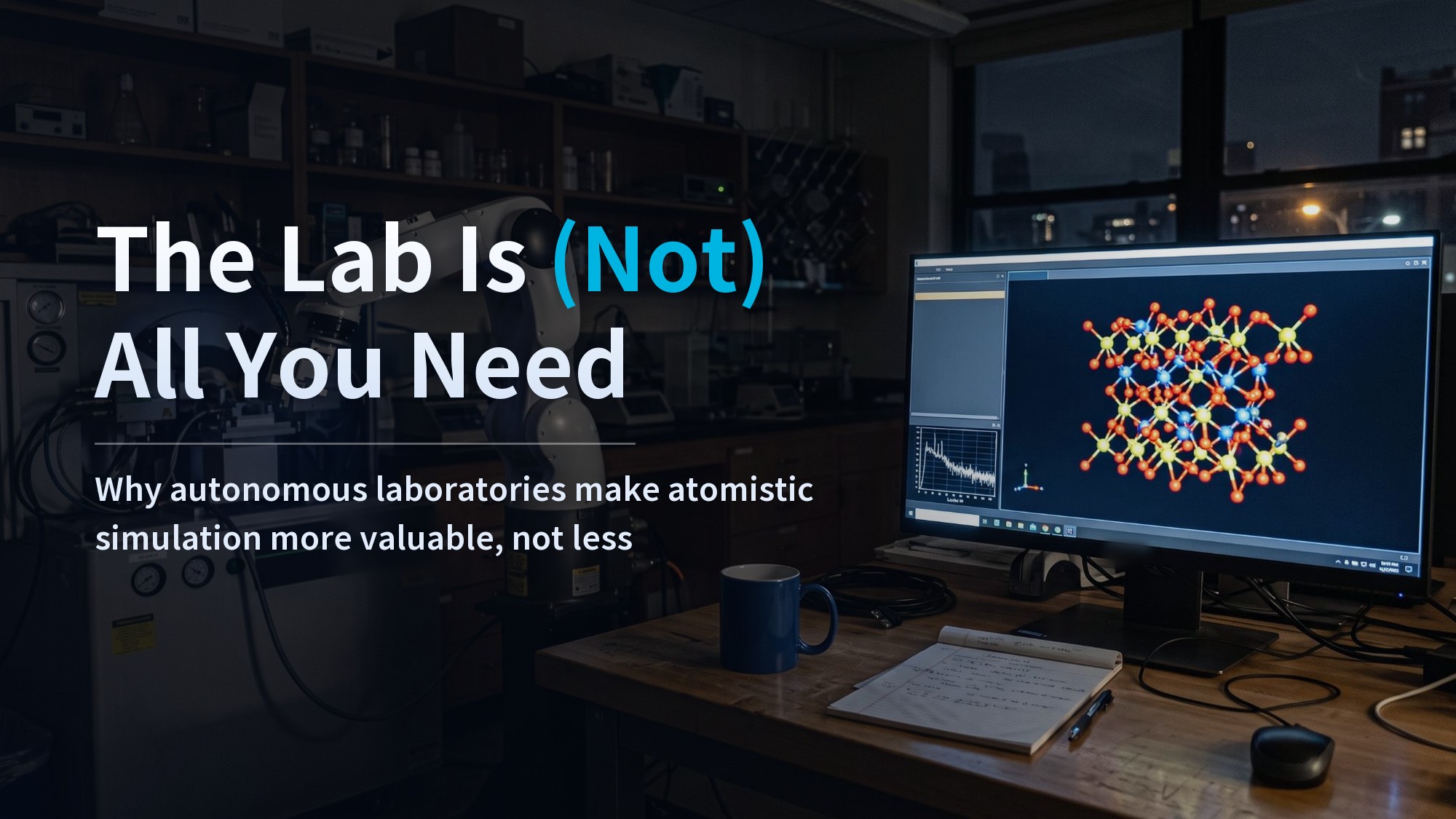
The Lab Is (Not) All You Need: Why autonomous laboratories make atomistic simulation more valuable, not less

Lab Automation Machine Learning Interatomic Potentials
The front runner of AI for Science – A Report from the "Matlantis User Conference 2026"
Conference Report

Changing the rules of materials development with Physics-Grounded AI: how Matlantis PFP came to be

Interview

Benchmarking Matlantis-PFP v9 on MLIP Arena (full version)
Introducing Matlantis-PFP v9: Benchmarking on MLIP Arena and Improving Experimental Agreement with r2SCAN
