
Lab automation (laboratory automation) is an approach that combines robots and software to automate and increase the autonomy of experimental and research processes. Its applications are wide-ranging, and there are many examples of its implementation, particularly in the life sciences and pharmaceutical fields. Meanwhile, in the field of materials development, the integration of equipment, data management, and even the autonomous exploration using AI are becoming increasingly relevant issues.
In materials development, the number of combinations of composition, structure, and process conditions to explore is enormous. Therefore, not only is automating experimental work important, but also streamlining and automating the decision-making process of "which candidate to try next"—in other words, "autonomy"—directly leads to a reduction in development time. This article will organize the overall picture of lab automation from the perspective of materials development and explain in detail everything from the automation of experimental work to autonomous materials discovery using AI.
The basics of lab automation: Automating experimental work
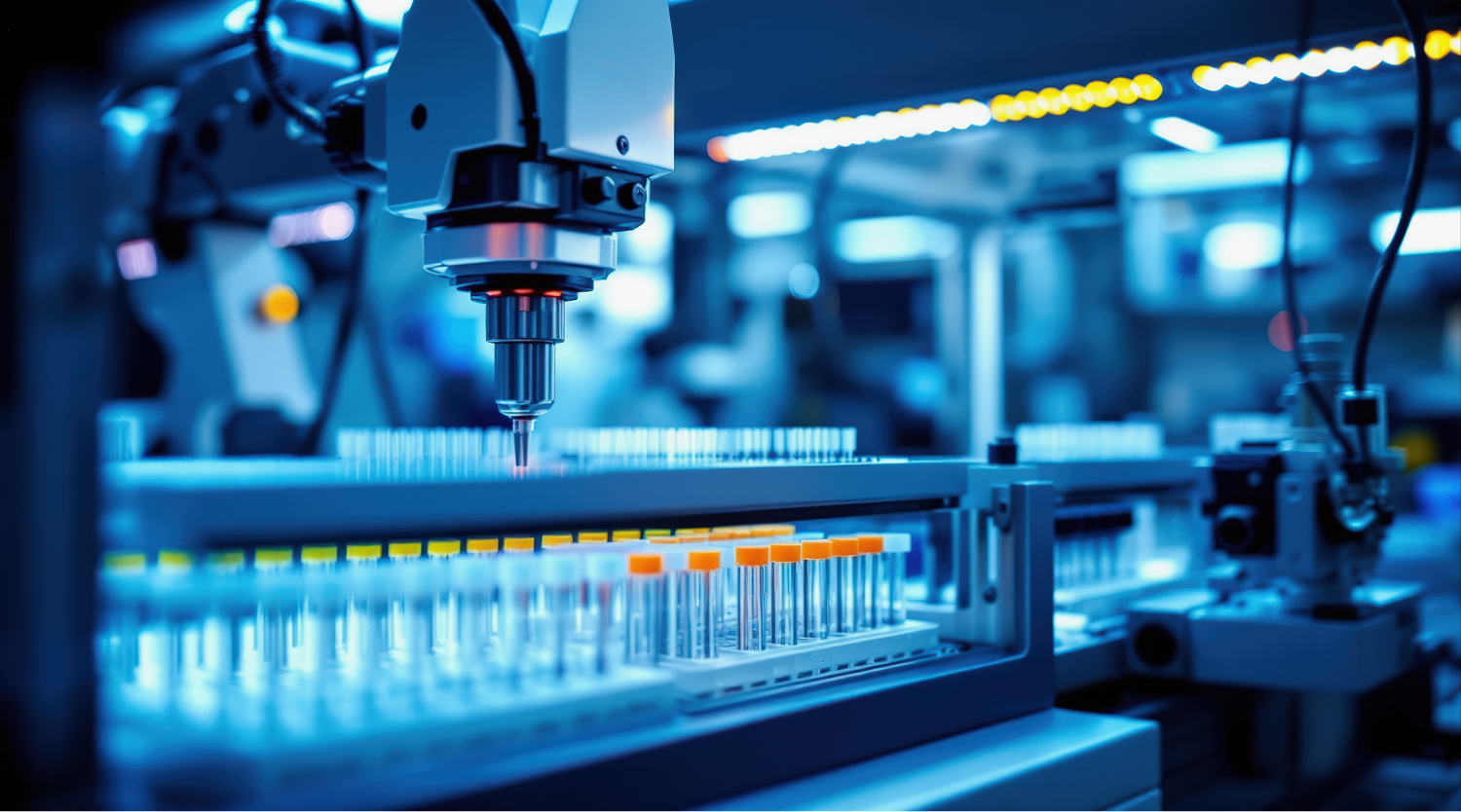
The fundamental principle of laboratory automation is to improve the efficiency and reproducibility of research and development by having robots and automated equipment perform repetitive tasks in the laboratory (such as transport, sample preparation, solution preparation, measurement, and data acquisition).
The automation of such tasks has been developed first in the life sciences and pharmaceutical fields. For example, "liquid handling (pipetting)," which involves precisely dispensing samples and reagents into small quantities, and "high-throughput screening," which involves evaluating thousands or tens of thousands of compound candidates in a short time, are typical applications of laboratory automation.
The market size for laboratory automation is estimated to be approximately US$7.3 billion in 2025 and is projected to reach approximately US$10 billion by 2030 [1]. The market is expected to continue expanding, with further adoption by research institutions and companies anticipated.
In recent years, automation through laboratory automation has been spreading in the materials field as well. For example, efforts are underway to streamline the entire process from synthesis to evaluation by connecting thin-film deposition equipment and X-ray diffraction (XRD) equipment with automated transport. Furthermore, in order to save data obtained from robots and automated equipment in a format that can be compared and reused, it is important to design data management systems such as electronic laboratory notebooks (ELNs) and laboratory information management systems (LIMSs) as components of laboratory automation.
Lab automation enables automation
In the materials field, laboratory automation can automate the following processes. Furthermore, it is possible to automate a series of multiple processes by combining automation equipment for each process.
- Synthesis: Automating processes for creating materials, such as preparing and mixing solutions, firing powder materials in an automated furnace, and depositing thin films using a sputtering device.
- Sample transport: The transfer of samples from the synthesis device to the measurement device is automated using robotic arms and transport rails.
- Measurement and Analysis: Automated evaluation of physical properties using XRD devices, spectrometers, electrochemical analyzers, etc.
- Data acquisition and recording: Measurement results from each device are automatically registered to LIMS and ELN, and the records are centrally managed.
Benefits of automation through lab automation
The automation of experimental work can bring the following main benefits to the field of materials development:
- Improved experimental speed: Continuous 24-hour operation and parallel processing can significantly increase the number of trials per unit of time.
- Improved reproducibility and accuracy: Eliminates variations in procedures, allowing for stable and repeatable experiments under identical conditions. Automatically recording the obtained data also helps prevent missed recordings and input errors.
- Reduced reliance on individual expertise: This allows for operation that does not depend on the skills of specific researchers, minimizing the impact of personnel changes and handovers.
- Ensuring worker safety: By entrusting the handling of hazardous reagents and repetitive tasks in high-temperature environments to robots, worker risks are reduced and safety is ensured.
The evolution of lab automation: From "automation" to "autonomy"
As discussed above, automating experimental tasks through lab automation improves the speed and reproducibility of individual tasks. However, in the field of materials development, the exploratory space is vast and each experiment often takes a long time. Therefore, how the results are interpreted and which conditions or material candidates to try next greatly influences the overall development speed.
What is needed is "autonomy," which entrusts this decision-making process to software such as AI [2]. By combining the "automation" of experimental work, which has been explained so far, with the "autonomy" of deciding what to try next, it becomes possible to continue the material development exploration cycle (hypothesis formulation → candidate selection → verification → result interpretation → next hypothesis formulation → ...) while reducing human involvement. This cycle, in which the system consistently handles everything from the execution of experiments to the decision-making, is called a "closed loop."
The trend in lab automation is thus evolving in the direction of "automation → autonomy" [2].
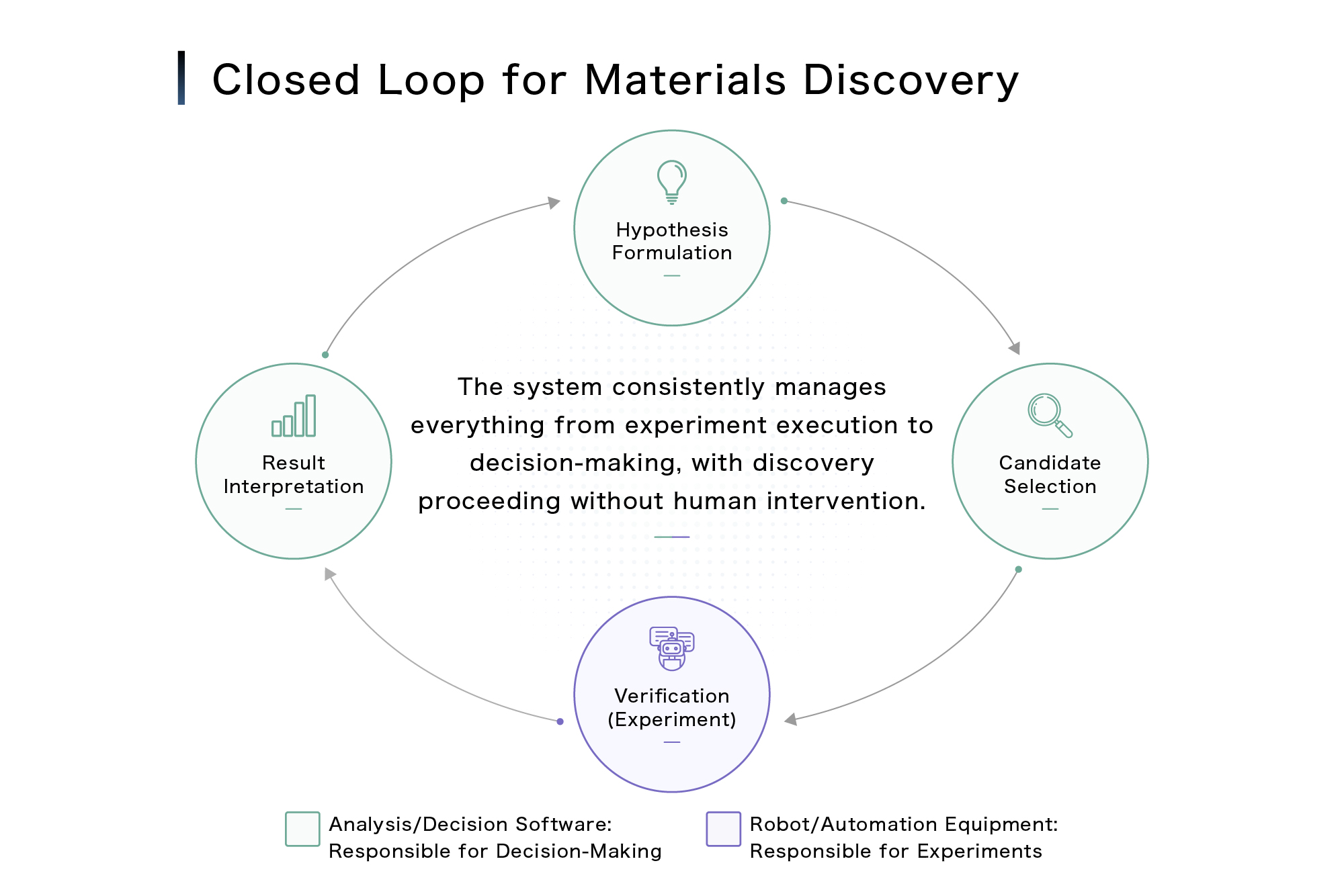
Figure: Closed-loop material discovery. This system divides the tasks of the discovery cycle, which were traditionally handled by researchers, between automated equipment and software (such as AI) that handles analysis and decision-making. Experimental tasks such as synthesis, measurement, and data recording (the "verification" step in the figure) are handled by automated equipment, while the analysis and decision-making software handles the analysis of the obtained data, interpretation of the results, and selection of conditions and candidates to try next (the "result interpretation," "hypothesis formulation," and "candidate selection" steps). By linking these cycles, discovery can proceed while reducing human involvement.
Technologies supporting "autonomy" in lab automation
The key technologies supporting the autonomous decision-making capabilities of the judgment and analysis software described earlier are "machine learning" and "material simulation." Below, we will explain the roles these technologies play in laboratory automation.
Machine Learning – Finding promising candidates with fewer experiments
Machine learning is a general term for technologies that use data patterns and regularities to teach computers and apply them to predictions and decisions. In the field of materials science, an initiative called Materials Informatics (MI) is spreading, which utilizes machine learning to streamline material discovery.
Within MI (Model Inventory), there is a technique called "adaptive experimental design," which involves selecting which conditions to evaluate next as the exploration progresses. In adaptive experimental design, candidates for the next experiment are selected based on the experimental results obtained so far, and the model is updated with newly obtained experimental data as the exploration continues. By repeatedly updating the model in this way, it is possible to efficiently approach promising candidates even with a limited number of experiments.
One of the representative methods of adaptive experimental design is "Bayesian optimization" [3]. A characteristic of Bayesian optimization is that it selects the next experimental candidate by considering the prediction results obtained from previous experimental data and their uncertainty (such as the standard deviation). By prioritizing "promising candidates" while also exploring candidates that have not yet been sufficiently investigated, it is possible to reduce the bias in the search.
If you'd like to learn more about MI and Bayesian optimization, please also check out our blog post, "What is Materials Informatics (MI)? A clear explanation from basic concepts to the latest research."
Material simulation – Narrowing down candidates and improving the efficiency of the search.
Materials simulation is a general term for methods that calculate the physical properties and behavior of a material based on physical laws, using its structure and composition as input. Depending on the scale being studied, there are various methods ranging from atomic and molecular level simulations (DFT calculations, molecular dynamics methods, etc.) to mesoscale and macroscale simulations [4]. For example, atomic and molecular level simulations can calculate the stability of a defined structure, the movement of atoms, and the pathways of chemical reactions. Adsorption behavior, diffusion properties, and interface stability, which are difficult to observe directly in experiments, can also be estimated [5].
(Density functional theory (DFT) and molecular dynamics are commonly used methods for simulating materials at the atomic and molecular level. For more detailed information on each, please refer to our blog articles "[For Beginners] What is Density Functional Theory (DFT)? | Basics" and"Introduction to Molecular Dynamics Simulation.")
The use of material simulations in laboratory automation can be broadly divided into the following two patterns:
Pattern A: Perform material simulation before closing the loop (narrow down candidates in advance)
In materials development, it is not uncommon for the number of candidates to be extremely large. If we try to explore all of these candidates in a closed loop, even with efficiency improvements using Bayesian optimization, it will take a lot of time and money to arrive at a material with the desired performance.
Therefore, an effective approach is to narrow down the candidates to some extent using material simulations before running the closed-loop simulation. By evaluating the stability and physical properties of candidate materials in advance through calculations, and then selecting only promising candidates for the closed-loop search, the search efficiency can be improved.
Pattern B: Perform material simulations within a closed loop (to support decision-making during exploration)
Another application is integrating materials simulation into a closed-loop system. For example, when adaptive experimental design proposes candidates or conditions to be evaluated next, materials simulation is used to confirm their validity and potential. Then, based on the results, a decision is made on whether to actually synthesize and evaluate those candidates. This reduces unnecessary experiments and makes the search more efficient.
However, with this method, if time-consuming material simulations are performed every time, the candidate evaluation process can become the rate-limiting step, slowing down the overall closed-loop speed. Therefore, instead of using costly methods like DFT every time, it is necessary to use faster methods or machine learning models that have been trained on calculation results in advance [6].
Examples of lab automation

Here are some examples of lab automation that have achieved the "automation" and "autonomy" concepts we have discussed so far.
An example of autonomously searching for synthesis conditions using robots and Bayesian optimization.
A group led by Professor Taro Hitosugi of the University of Tokyo has constructed a "digital laboratory" that autonomously optimizes the synthesis conditions of LiCoO₂ thin films, known as battery materials, by interconnecting multiple experimental devices and combining automation by robots with decision-making based on Bayesian optimization.[7]
In this system, the crystal structure of thin films automatically synthesized by a sputter deposition system is automatically measured by an XRD instrument. Subsequently, the intensity ratio of diffraction peaks characteristic of LiCoO₂ is calculated from the obtained XRD pattern, and based on this result, Bayesian optimization proposes the next synthesis conditions, and thin films are synthesized under the new conditions. Professor Hitosugi and his colleagues succeeded in autonomously discovering the synthesis conditions for high-quality LiCoO₂ thin films by repeating this cycle without human intervention.
Furthermore, this research also focuses on data standardization. Measurement data from each experimental device is output in a standard format called MaiML (JIS K 0200) and aggregated in a cloud-based database. This enables a system that allows for unified management and comparison of data from different devices.
An example of integrating thermodynamic calculations into a closed loop to autonomously search for a phase diagram.
Integrating material simulations into a closed loop makes it possible to efficiently understand phase diagrams and phase boundaries. One example of this is AMASE (Autonomous Materials Science and Engineering), an autonomous materials discovery engine reported by a research group from the University of Maryland and NIST (National Institute of Standards and Technology) [8].
AMASE uses "CALPHAD," a system that calculates phase diagrams based on thermodynamic models, for material simulation. First, XRD measurements are performed on thin film samples of Sn-Bi alloys to determine which phases appear at which compositions and temperatures. Then, based on these results, AMASE software updates the phase diagram prediction using CALPHAD and automatically determines, using adaptive experimental design, which compositions and temperatures should be used for the next XRD measurement. Furthermore, the next measurement is performed according to this determination, and the obtained results are reflected in the phase diagram calculation again, thereby narrowing down the phase boundaries.
The research group demonstrated that the eutectic phase diagram of the Sn-Bi system can be efficiently determined by repeating this cycle without human intervention.
Matlantis: An AI-powered atomic simulator supporting lab automation.
The "materials simulation" technology introduced in this article as a technology supporting the "autonomization" of lab automation is capable of highly accurate calculations at the atomic level, but its long computation time and high computation cost are often drawbacks. Therefore, it can be difficult to use in applications such as comparing many candidates in the early stages of exploration or evaluating the next candidate to try each time during a closed-loop process.
One new approach that is attracting attention to solve these challenges is "Matlantis," which we offer. Matlantis is a cloud service that uses AI to perform highly accurate atomic-level simulations at significantly faster speeds than before. By enabling calculations in a short time, it becomes easier to compare many candidates and narrow down the promising ones before experiments, and even during the closed-loop process, it becomes easier to proceed with the search while calculating the next candidate to try.
For specific examples of how to use Matlantis and the benefits of implementing it, please see our customer case studies page.
Summary
This article explained laboratory automation in materials development, from automating experimental work and autonomous decision-making to the use of machine learning and materials simulation in autonomous processes.
In materials development, the decision of "what to try next" greatly influences the development speed. When considering lab automation, it is important to look at it not only from the perspective of automating experimental work, but also from the perspective of pursuing autonomy across the entire discovery process of your company by utilizing machine learning and materials simulation.
For those who want to understand the current state of materials simulation: We offer a free research report.
For those who want to easily catch up on the latest trends in "materials simulation," which underpins lab automation, we offer a free research report. Please feel free to use it as material for internal presentations and proposals.
This document analyzes over 100,000 research papers to visualize trends in the application of computational chemistry in the materials science field and identify future growth areas. It provides insights useful for selecting research themes and considering methods for promoting R&D digital transformation (DX).
This report analyzes the actual use of AI-driven simulations in materials research and development, based on survey data from 300 experts in materials science and engineering in the United States. It provides insights into real-world challenges and solutions for promoting R&D DX, including the impact of computational resource bottlenecks and methods for balancing speed, accuracy, and reliability.
[References]
[1] 360iResearch「Laboratory Automation Market – Global Forecast 2026-2032」: https://www.360iresearch.com/library/intelligence/laboratory-automation
[3] Matlantis blog, "What is Materials Informatics (MI)? A clear explanation from basic concepts to the latest research": https://matlantis.com/ja/resources/blog/what-is-materials-informatics/
[5] Matlantis blog, "What is Density Functional Theory (DFT) for Beginners? | Basics": https://matlantis.com/ja/resources/blog/dft/
-


 URL
URL
Copied
New Articles
NEW
Benchmarking Matlantis-PFP v9 on MLIP Arena (full version)

NEW
Introducing Matlantis-PFP v9: Benchmarking on MLIP Arena and Improving Experimental Agreement with r2SCAN
NEW
How to Choose Molecular Dynamics (MD) Simulation Software: 6 Key Points and 14 Tools Compared

Molecular Dynamics Explainer

[Presentation Report] Tokyo University of Agriculture and Technology Doctor's Café #37 & AI Salon #14
Conference Report
![[Presentation Report] Tokyo University of Agriculture and Technology Doctor’s Café #37 & AI Salon #14](https://matlantis.com/wp-content/uploads/2026/07/tuat-doctors-cafe-37-ai-salon-14-1.jpg)
Micro-Physical AI: Another invisible form of physical AI and the future of materials development

CEO Blog