
2026.5.27
プレスリリース
製品・サービス
Matlantis、AIエージェント連携機能を提供開始
自然言語でシミュレーションコードを自動生成-計算化学にハードルを感じる方でも材料研究を
Matlantis株式会社(本社:東京都千代田区、代表取締役社長:岡野原大輔、以下「Matlantis」)は、汎用原子レベルシミュレータ「Matlantis™」において、AIエージェント連携機能を本日より提供開始します。
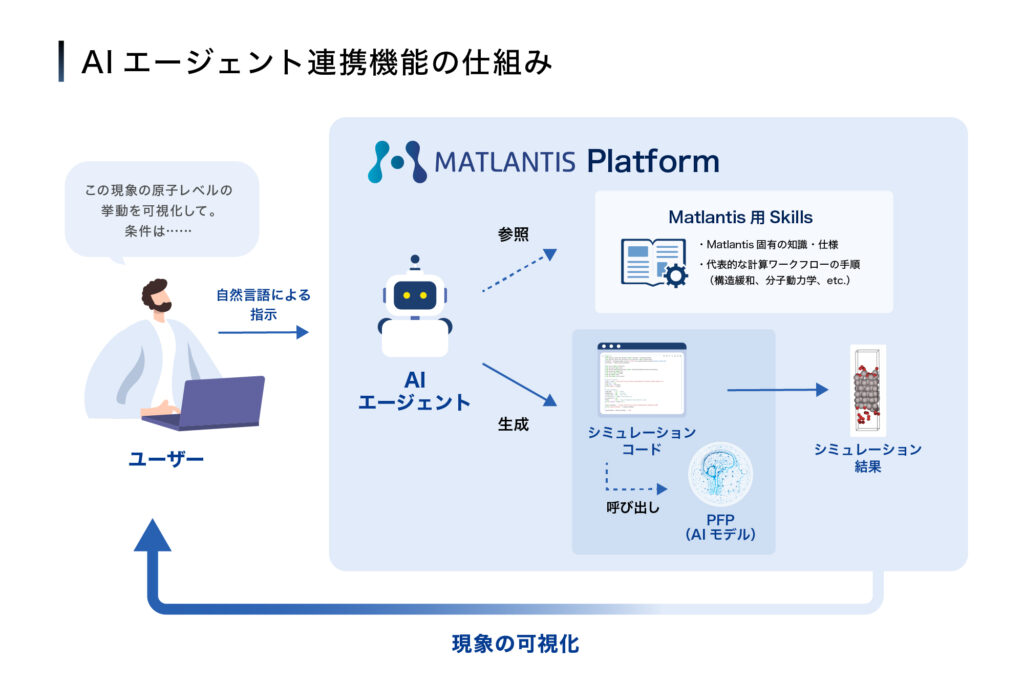
AIエージェント連携機能は、対話型AIエージェントであるAnthropic社の「Claude Code」やOpenAI社の「Codex」を、Matlantisのターミナル環境上でシームレスに扱うための連携機能です。また、汎用的なAIに対してMatlantis特有の機能や仕様を参照させるための知識集「Skills」を、先行してGitHubにて公開いたしました。本連携機能を通じてターミナルからAIエージェントを起動し、そこにSkillsの専門知識を読み込ませることで、ユーザーは自然言語の指示のみでシミュレーションコードの作成および編集作業を効率的に進めることが可能となります。
背景:計算化学の事業応用における障壁とAIエージェントの発展
計算化学は、材料研究におけるミクロな現象の可視化や理論的示唆の提示など、重要な役割を果たしてきました。しかし、膨大な計算コスト、計算資源やソフトウェアの環境構築・運用、そして対象材料のドメイン知識・計算化学の理論・プログラミングといった広範な専門性が求められることから、長らく研究用途が中心となってきました。
Matlantisは、量子化学計算を置き換える高速・高精度なAIモデル「PFP(Preferred Potential)」を主軸に、環境構築の不要なクラウドサービスとして、これらのハードルの大部分を取り除いてきました。それでも、新しい解析を試したいときや論文を再現したいとき、自社固有の系を扱いたいときには、Pythonコードの記述や既存スクリプトの編集が必要であり、ここに学習の壁が残っていました。
大規模言語モデル(LLM)を中核としたAIエージェント技術は、この2年で急速に成熟し、コーディング・調査・文書作成といった知的業務の生産性向上に直結する手段として、企業導入が広がっています。AIエージェント連携機能は、計算化学の事業応用における「最後の壁」を取り除き、Matlantisの価値をより広い研究者層へ届ける取り組みです。
どのような研究者に、どのような価値をもたらすか
実験を中心に研究を進めてきた研究者の方に:計算化学やプログラミングの専門知識に自信がなくても、AIエージェントとの自然言語による対話を通じてシミュレーションを実行できます。例えば実験では直接見えないミクロな現象を知りたいという際には、現象を可視化するためのシミュレーションプログラムを作成するだけでなく、結果の解釈まで行えます。
計算化学を専門としてきた研究者の方に:コーディングにかかる時間が大幅に短縮されることで、論文の再現実装や、可視化・スクリーニングなどの検討サイクルを高速化します。これにより、「まず動かしてみて考える」というスピード感で試行錯誤を進められるようになります。また、既存のスクリプトをAIエージェントに参照させ、自身の研究に合わせて出力を最適化させることも可能です。
研究マネジメントを担う方に:PFPによる高速計算とAIエージェントの組み合わせにより、チーム全体の試行サイクルが大幅に短縮されます。これまで時間制約から諦めていたテーマや、後回しになっていた検討にも「計算上でまず試す」というアプローチが可能となり、偶然的発見を促します。また、組織内の幅広いテーマに、計算による課題解決が適用できるようになります。
提供内容
(1)Matlantis用Skills ― 公開リポジトリで配布
Matlantisの機能・仕様・APIなど、Matlantis上でシミュレーションのスクリプトをAIエージェントに書かせるために必要な知識・手順を、Skillsとして整備し、公開リポジトリで配布しました。AIエージェントはそのままでもLLMに学習された知識を活用できますが、学習範囲には含まれないMatlantis固有の知識や代表的な計算ワークフロー(構造緩和、分子動力学、反応経路探索、結晶構造予測、可視化、外部データベースからの構造取得など)をSkillsから読ませることで、より適切な出力が可能となります。
(2)AIエージェントの機能連携 ― Matlantisターミナル上で動作
Matlantis環境のターミナルから直接AIエージェントであるClaude CodeやCodexを起動できるインストーラを近日提供予定です。ユーザーはMatlantis内のターミナル上でClaude CodeやCodexを起動することで、シミュレーションプログラムの作成・編集から、シミュレーション結果の読み取り・解釈までを直接行えるようになります。
代表取締役社長 岡野原大輔のコメント
「Matlantisは、計算化学の専門家でなくとも材料の挙動を高い精度で高速に予測できるシミュレーション基盤を提供してきました。AIエージェント連携機能は、その入口をさらに広げる取り組みです。私たちが目指すのは、テキスト世界の知識にアクセスするのと同じ手触りで、物理世界に存在する未発見の『知』に自然言語でアクセスできる研究開発体験です。今回の発表は、その第一歩にあたります。」
今後の展望
Matlantisは引き続き、AIエージェントと組み合わせた研究開発体験の向上に取り組みます。Skillsの継続的な拡充を通じて、AIエージェント時代の材料研究開発のあり方を、お客様と共に形作っていきます。
私たちは今後も、すべての研究者の皆様に、計算を通じた最高のソリューションを提供し続けるべく尽力いたします。
関連ウェビナー開催のお知らせ
本機能の提供開始に伴い、AIエージェントを活用したシミュレーションコード生成の具体的なワークフローを紹介するウェビナーを6月23日に開催いたします
詳細・お申し込み:https://matlantis.com/ja/resources/event-seminar/coding-agent-workflow/
Matlantis株式会社について
Matlantisは、革新的な材料・素材の創出を通じて持続可能な世界の実現を目指し、2021年に株式会社Preferred NetworksとENEOS株式会社の合弁会社として、株式会社Preferred Computational Chemistryとして設立されました(2025年7月よりMatlantis株式会社へ社名変更)。
提供する汎用原子レベルシミュレータ「Matlantis™」は、材料特性の原子レベルでの現象解明や新素材開発を実現するためのクラウドサービスです。従来の原子シミュレータに機械学習原子間ポテンシャルを組み込むことで、計算スピードを従来の数万倍に高速化し、幅広い物質への適用を可能にしました。
現在、日本国内を中心に150以上の企業や大学などの研究機関で利用されており、2023年からは海外展開も開始し、GE Vernova(米)やフォルクスワーゲン(独)などへの導入も進んでいます。
ウェブサイト:https://matlantis.com/ja
本件に関するお問い合わせ先
Matlantis株式会社 広報担当:堀野
Email:pr@jp-matlantis.com
New integration lets researchers create, edit, and run simulations through natural language, extending advanced computational chemistry to non-specialists.
Cambridge, Mass and TOKYO, May 27, 2026 — Matlantis, a leading provider of AI-powered atomistic simulation for industrial materials R&D, today announced a new AI agent integration for its universal atomistic simulator that lets researchers build and run simulations using natural-language instructions. The release includes a public Skills library on GitHub, available immediately, and an upcoming installer that will run Anthropic’s Claude Code directly inside the Matlantis terminal environment.
Atomistic simulation has long required a combination of computational chemistry knowledge, programming fluency, and environment expertise, a barrier that has kept the technology in the hands of specialists even as the rest of materials R&D has become more cross-functional. Matlantis already removed much of the infrastructure burden by delivering its high-accuracy AI model, PFP (Preferred Potential), as a cloud service. This release targets the last remaining barrier: the scripting layer that sits between a researcher’s question and a working simulation.
The integration arrives as AI agents move from experimentation to production use in technical workflows. By embedding Claude Code inside Matlantis and giving it access to a domain-specific Skills library, Matlantis is connecting general-purpose agent capability to the specialized procedures and APIs that simulation work actually requires.
“Simulation has always had three barriers: the infrastructure, the science, and the scripting. We’ve spent five years removing the first one,” said Daisuke Okanohara, President & CEO, Matlantis. “This release is about removing the third, and it changes who can credibly do atomistic simulation inside an R&D organization.”
A public Skills library, available now
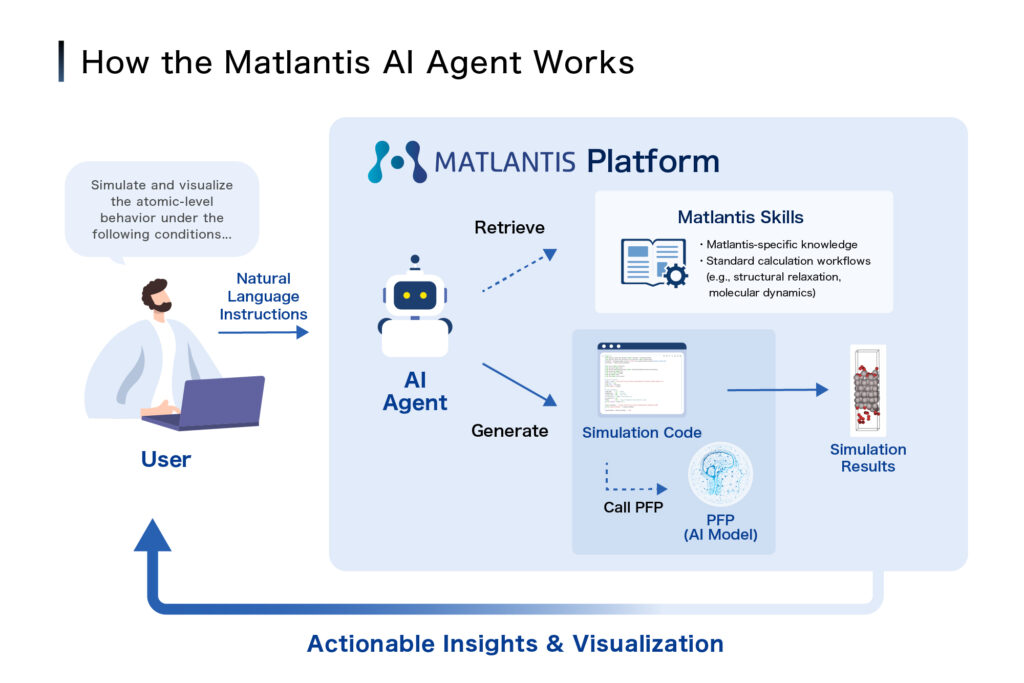
The Skills library, released on GitHub, packages Matlantis-specific knowledge—functions, APIs, and representative workflows—into a format that general-purpose AI agents can load and reference. This gives agents access to expertise that isn’t present in their underlying training data, allowing them to generate more accurate, context-aware simulation scripts on the first attempt. Initial workflows include structure relaxation, molecular dynamics, reaction pathway exploration, crystal structure prediction, visualization, and retrieving structures from external databases. The library will expand as customer use cases evolve.
Claude Code, embedded in the simulation environment
An installer scheduled for release in a forthcoming update will let users launch Anthropic’s Claude Code directly from the Matlantis terminal. Running the agent in-context means researchers can describe what they want to simulate in plain language, generate or edit the underlying scripts, run the calculation, and interpret outputs, all without leaving the workflow. For experimental researchers who lack programming fluency, this opens up simulation as a practical tool. For computational specialists, it removes the repetitive scripting work that typically sits between hypothesis and result.
What it changes for R&D teams
Experimental researchers can now generate and interpret simulations through conversation rather than code. Computational chemistry specialists can compress the time spent reproducing published analyses, screening candidates, and adapting workflows for new systems, adopting a “try first, analyze second” cadence. R&D leaders gain the ability to apply computational methods to a broader range of research themes, including questions that were previously deprioritized because they didn’t justify the specialist time required to set them up.
“Matlantis already enables non-specialists to predict material behavior with high accuracy and speed,” said Okanohara. “With AI agents now a practical interface for complex tools, we can close the remaining gap between a researcher’s question and a running simulation. The goal is to make undiscovered knowledge in the physical world as accessible through natural language as knowledge in the textual world has become.”
Availability
The Matlantis Skills library is available now on GitHub. The installer that enables Claude Code to run inside the Matlantis terminal environment will be released in a forthcoming update. For more information, visit matlantis.com.
About Matlantis
Jointly developed by PFN and ENEOS, Matlantis is a universal atomistic simulator that supports large-scale material discovery by reproducing new materials’ behavior at an atomic level on the computer. PFN and ENEOS have incorporated a deep learning model into a conventional physical simulator to increase the simulation speed by tens of thousands of times and to support a wide variety of materials. Matlantis was launched in July 2021 as a cloud-based software-as-a-service by Matlantis Corp. (formerly named Preferred Computational Chemistry), a company jointly invested by PFN, ENEOS and Mitsubishi Corporation.
Matlantis is used by over 150 companies and organizations for discovering various materials including catalysts, batteries, semiconductors, alloys, lubricants, ceramics and chemicals. For more information, please visit: https://matlantis.com/en/.
Media Contact:
Emily Townsend
Scratch Marketing + Media for Matlantis
matlantis@scratchmm.com
-


 URLを
URLを
コピーしました
関連ニュース
-
2026.9.17プレスリリースNEW
-
2026.9.16プレスリリース
-
2026.8.21製品・サービス
Matlantis PFP v9、機械学習ポテンシャルの公開ベンチマーク「MLIP Arena」の総合ランキングで同率1位
